

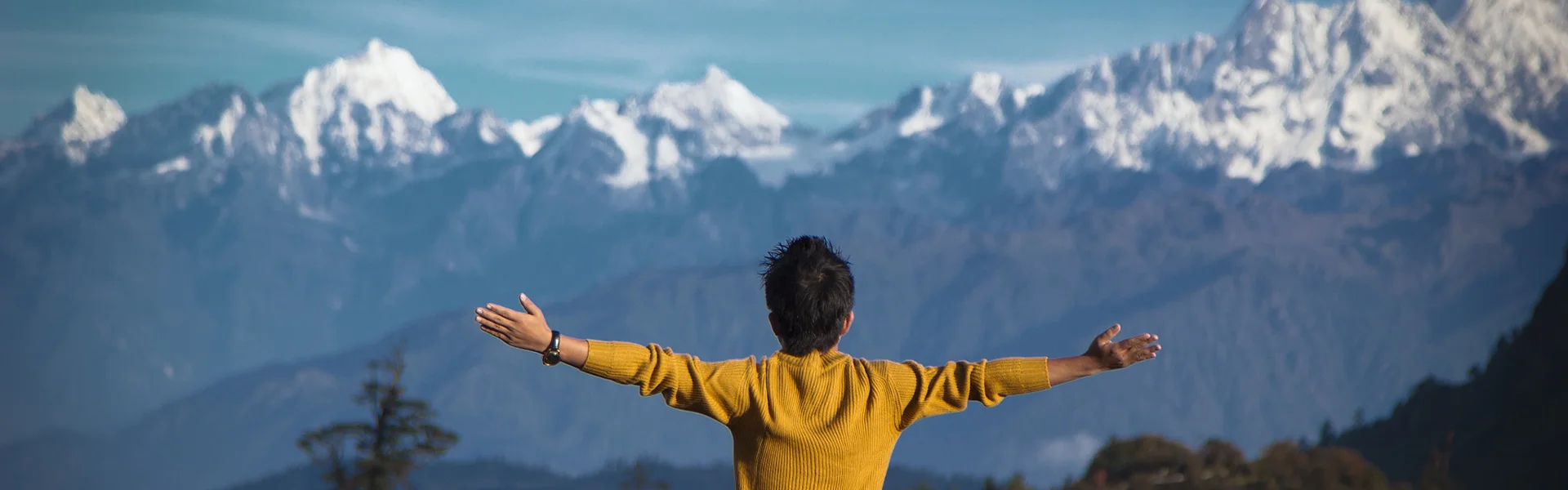

Bhutan Travel from India offers a unique opportunity to explore a kingdom that values happiness and nature. Strong cultural ties between the two nations create a friendly environment for visitors. Indian citizens enjoy special travel privileges because of the 1949 treaty between India and Bhutan. These rules allow for easy entry without a traditional visa. Most people find the trip to Bhutan from India the simplest international trip from the Indian subcontinent. Road trips remain a top choice for travelers from neighboring Indian states such as West Bengal and Assam.
Why Bhutan Travel from India Stands Out
Strong geographical links make Bhutan an accessible neighbor for Indian residents. The land border provides several entry points that connect directly to the plains of India. Indian travelers do not face the same strict visa processes as other international guests. Bhutan Travel from India relies on a simple permit system instead. This system supports quick travel planning for families and solo explorers. The shared history between the two countries ensures that local people welcome Indian visitors with warmth.
The table below highlights the core benefits of choosing Bhutan for your next international trip.
| Feature | Benefit for Indian Citizens |
| Visa Requirement | No visa needed; entry permit only |
| Identification | Voter ID or Passport accepted |
| Access | Multiple land and air entry points |
| Currency | The Indian Rupee is widely accepted |
| Logistics | Ideal for road trips and budget travel |
Essential Entry Requirements for Indian Citizens
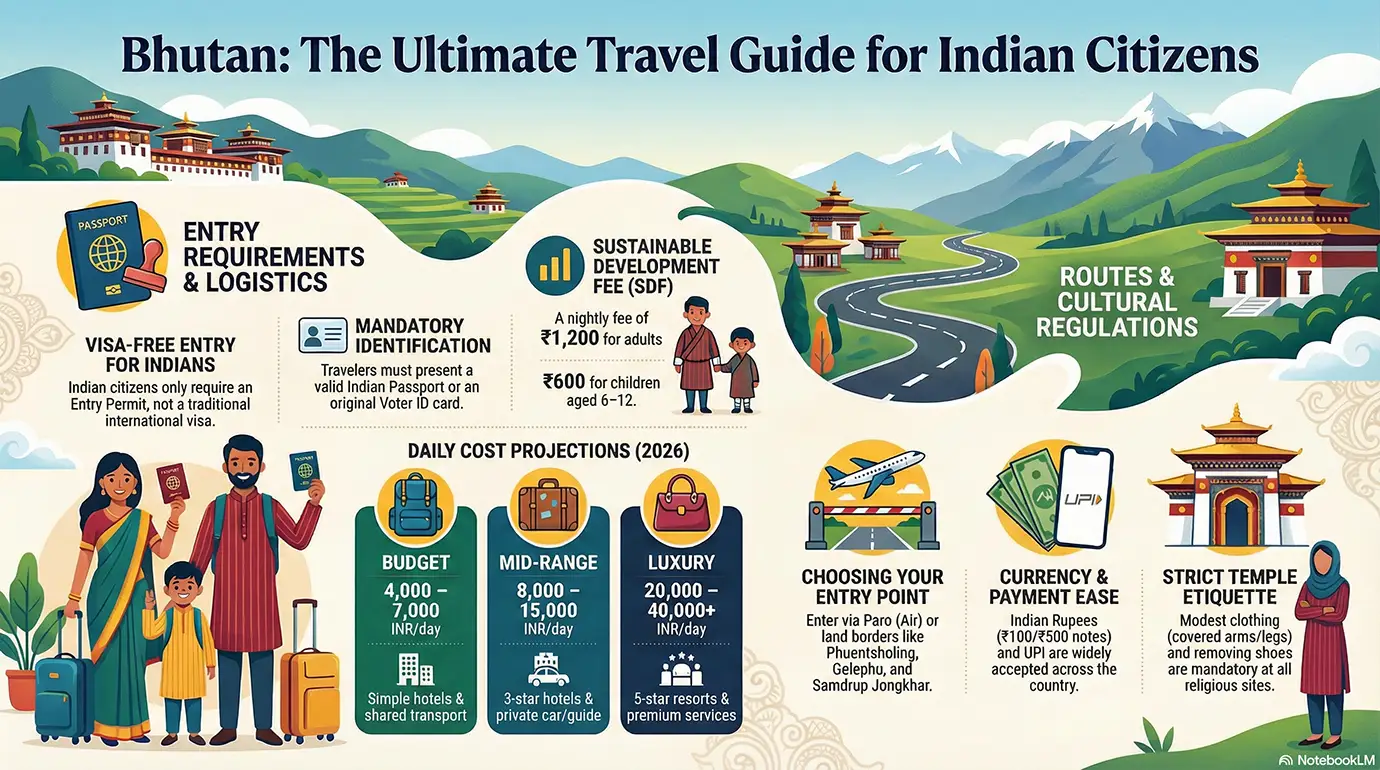
Indian citizens must follow specific rules to enter the kingdom legally. While a visa remains unnecessary, travelers must obtain an entry permit. This permit acts as the official document for your stay.
Valid Identification Documents
Travelers must carry specific ID cards to clear immigration checkpoints. The Department of Immigration accepts only a few types of documents for entry.
| Category | Accepted Document | Validity/Note |
| Primary ID | Valid Indian Passport | Minimum 6 months validity |
| Secondary ID | Original Voter ID Card | Issued by the Election Commission of India |
| Minor (under 18) | Original Birth Certificate | Only if no passport is available |
| Photographs | Passport-size color photos | Carry at least 3-4 copies |
Children under 18 years must travel with a legal guardian. They need a birth certificate or a passport to prove their identity. Aadhaar cards and driving licenses do not serve as primary travel documents for entry. Carrying several photocopies of these documents helps during the permit process.
The Entry Permit Process
Travelers obtain the entry permit at the point of arrival. It includes the Paro International Airport or land border offices like Phuentsholing. The initial permit usually allows visits only to Paro and Thimphu.
- Visit the immigration office at the border or airport.
- Submit the completed application form with photos.
- Provide proof of a hotel booking for certified accommodations.
- Pay the mandatory Sustainable Development Fee.
- Receive the permit stamp in your passport or on a separate paper.
The online permit portal provides a faster way to handle these steps. Pre-registration online reduces waiting time at busy border gates. Most online applications take around two working days to process. Travelers can track their application status through the official portal.
Understanding the Sustainable Development Fee (SDF)
Bhutan uses the Sustainable Development Fee to protect its environment and culture. This fee funds free healthcare and education for local citizens. Indian nationals pay a lower rate compared to other international visitors.
| Age Group | SDF Rate per Night (INR) |
| Adults (12 years and above) | 1,200 |
| Children (6 to 12 years) | 600 |
| Infants (Below 6 years) | 0 (Exempt) |
The fee applies for every night you spend in the country. Travelers must pay this amount during the permit application process. Day visitors to border towns like Phuentsholing do not pay the SDF until they move past certain checkpoints. The government uses these funds to maintain mountain trails and preserve historic temples. If you cancel your trip, you can apply for an SDF refund online.
Mainland Entry Points for Bhutan Travel from India
Three major land borders connect India to Bhutan. These gateways offer different routes into the kingdom.
Phuentsholing: The Popular Gateway
Phuentsholing sits in the south and borders the Indian town of Jaigaon in West Bengal. Most visitors choose this point for Bhutan Travel from India.
- Location: Opposite Jaigaon, West Bengal.
- Distance: 165 km from Siliguri and 170 km from Bagdogra.
- Processing: The new Pedestrian Terminal handles all immigration work.
- Travel: The drive to Thimphu or Paro takes about 6 hours from here.
Phuentsholing serves as the commercial center. It has many hotels, restaurants, and shops for early arrivals. Travelers often spend their first night here to finish permit paperwork early the next morning.
Gelephu: The Central Entry Point
Gelephu connects with the Indian state of Assam. It provides a quieter alternative for those coming from Northeast India.
- Location: Borders Sarpang district, near Bongaigaon in Assam.
- Distance: 250 km from Guwahati.
- Pros: Less crowded than Phuentsholing and very scenic.
- Cons: The drive to Thimphu takes about 10 hours from here.
Gelephu offers a unique look at the sub-tropical regions of the kingdom. Road conditions here remain generally good for cars and bikes.
Samdrup Jongkhar: The Eastern Gateway
Samdrup Jongkhar sits on the border with Assam and serves as the entry for eastern Bhutan.
- Location: Borders Darranga in Assam.
- Distance: 150 km from Guwahati, roughly 3 hours by road.
- Purpose: Best for travelers visiting Trashigang or Mongar.
- Transit: Reaching Thimphu from here takes at least 3 days by road.
This town has a lively market atmosphere. It serves as a staging ground for adventure seekers seeking offbeat villages.
Bhutan Travel from India by Road
Road trips allow travelers to see the changing landscape from the plains to the mountains. Several Indian cities serve as starting points for these trips.
Starting from Siliguri or Bagdogra
Siliguri acts as the central hub for travelers in West Bengal.
- Route: Siliguri to Jaigaon takes 4 to 5 hours.
- Transport: Daily buses leave from the Tenzing Norgay Bus Terminal.
- Taxi: Shared and private taxis are available for the drive to the border.
The road passes through beautiful tea gardens and the Dooars region. Most people arrive in Jaigaon by evening to enter Phuentsholing early the next day.
Starting from Guwahati
Guwahati provides easy access to the Assam borders.
The route from Guwahati to Samdrup Jongkhar takes about 3 to 4 hours.
- Route: Guwahati to Gelephu takes around 6 to 7 hours.
- Condition: The roads in Assam are wide and well-connected to the Bhutanese entry points.
Travelers often use Guwahati as a base because it has a major airport and railway station. It helps explorers reach the remote eastern parts of Bhutan quickly.
Self-Drive from India to Bhutan
Indian travelers can bring their own cars or motorcycles into the country. It requires extra steps and specific permits.
- Green Tax: A fee of 4,500 Nu (INR) per day applies to Indian vehicles.
- Guide: A licensed guide must accompany any self-driving group.
- Registration: You must register the vehicle on the Check Post Management System (CPMS).
- RSTA Permit: Visit the Road Safety and Transport Authority office at the border for an authorized letter.
Required documents for vehicles:
- Original Driving License.
- Registration Certificate (RC) of the car.
- Valid Vehicle Insurance.
- Pollution Under Control (PUC) certificate.
- An authorization letter if the driver is not the owner.
The vehicle should not be more than 10 years old from its registration date.
Bhutan Travel from India by Air
Flying provides the fastest way to reach the Paro valley. Paro International Airport sits at a high altitude surrounded by tall peaks.
Airlines and Major Routes
Only two airlines fly into the country: Druk Air and Bhutan Airlines.
| Origin City | Airline | Duration | Note |
| Delhi | Druk Air / Bhutan Airlines | 2h 15m | Daily flights available |
| Kolkata | Druk Air / Bhutan Airlines | 1h 15m | Most common air route |
| Guwahati | Druk Air | 45m | Shortest flight |
| Bagdogra | Druk Air | 1h | Seasonal schedules |
Flight prices for Indian nationals vary but usually range from 48,900 INR to 49,900 INR for a round-trip from Delhi. Travelers get amazing views of Mount Everest and Kangchenjunga during the flight.
Baggage Allowance Rules
Airlines maintain strict weight limits for safety in the mountains.
- Economy Class: 30 kg checked and 5 kg cabin bag.
- Business Class: 40 kg checked and 7 kg cabin bag.
- Excess Weight: Charges apply per kg, usually around 2-4 USD, depending on the route.
Cabin bags must fit in the overhead bin or under the seat. Maximum dimensions for hand luggage are 45 x 35 x 20 cm.
Detailed Route and Permit Planning
A standard entry permit only covers Paro and Thimphu. Explorers wanting to see more must apply for a Special Area Permit.
Getting the Route Permit
The Immigration Office in Thimphu issues these permits on working days.
- Locations Covered: Punakha, Wangdue, Bumthang, and eastern regions.
- Process: Visit the office between Monday and Friday.
- Documents: Bring your original entry permit and ID.
- Time: Most permits are ready within an hour of application.
Travelers should plan their visits to Thimphu during the week to avoid weekend closures. The route permit is necessary for every checkpoint beyond the capital.
Suggested 5-Day Bhutan Itinerary from India
A short trip focuses on the most famous sites in western Bhutan. This plan works well for those using the Phuentsholing border.
- Day 1: Enter via Phuentsholing. Finish paperwork and stay overnight in the border town.
- Day 2: Drive to Thimphu. The 6-hour drive offers views of the mountains and waterfalls. Visit the Buddha Dordenma in the evening.
- Day 3: Paro and Tiger’s Nest. Travel to Paro and hike to the famous cliffside monastery.
- Day 4: Punakha via Dochula Pass. See the 108 chortens at the pass and visit the Punakha Dzong.
- Day 5: Return to Phuentsholing. Drive back to the border for your exit to India.
For a longer 7 to 10-day trip, travelers can add visits to the Phobjikha Valley or the Bumthang district.
Travel Cost from India to Bhutan
Costs vary based on your comfort level and travel style. Indian travelers save money because they do not pay for a visa and have lower SDF rates.
| Budget Type | Estimated Daily Cost (INR) | Inclusions |
| Budget | 4,000 – 7,000 | Simple hotels, shared transport |
| Mid-Range | 8,000 – 15,000 | 3-star hotels, private car/guide |
| Luxury | 20,000 – 40,000+ | 5-star resorts, premium services |
Average prices for core services in 2026:
- Accommodation: 2,000 to 8,000 INR per night for mid-range hotels.
- Meals: 200-1,500 INR per person per meal.
- Private SUV Rental: 3,500 to 5,500 INR per day.
- Guide Fees: 1,500 to 3,000 INR per day.
Peak seasons like spring and autumn see hotel rates increase by 20% to 40%.
Best Time for Bhutan Travel from India
Weather plays an important role in planning your trip. The mountains experience very different conditions throughout the year.
Spring (March to May)
Valleys become colorful with flowers like rhododendrons.
- Weather: Clear skies and mild temperatures.
- Events: The Paro Tshechu festival takes place during this time.
- Pros: Best for trekking and hiking to Tiger’s Nest.
Autumn (September to November)
This season offers the best visibility for mountain peaks.
- Weather: Cool and crisp air with very little rain.
- Events: Thimphu Tshechu attracts many visitors.
- Pros: Ideal for photography and long road trips.
Winter and Monsoon
Winter (December to February) is cold but peaceful with fewer tourists. Monsoon (June to August) brings heavy rain and higher risks of landslides on mountain roads.
Currency and Payment Options
Bhutan and India share strong financial links. It makes spending money very easy for Indian guests.
- Rupees: 100- and 500-INR notes are widely accepted.
- UPI: Digital payments via BHIM and other UPI apps work at many shops.
- Ngultrum: The local currency (BTN) is worth the same as the Rupee.
- Cards: High-end hotels and shops in Thimphu accept international cards.
Travelers should carry some cash for remote areas where cell signal may be weak. Denominations larger than 500 INR are sometimes harder to use in small villages.
Staying Connected: Mobile and Internet
Indian SIM cards like Airtel and Jio work on roaming, but local SIMs are cheaper.
- Operators: TashiCell and B-Mobile are the two main networks.
- Tourist SIM: You can buy a SIM at the airport or border for 200-500 Nu.
- Data: Prepaid plans offer 4G and 5G speeds at affordable rates.
- Requirement: Show your permit and a photo to get a local number.
Most hotels offer free Wi-Fi, but the quality varies in mountain regions.
Cultural Etiquette for Indian Travelers
Bhutanese people value their traditions and respect for sacred places. Following local customs ensures a positive experience.
Dress Code for Dzongs and Temples
Modest clothing is mandatory when visiting religious sites.
- Arms and Legs: Must be fully covered.
- Collars: Men should wear collared shirts.
- Footwear: Remove shoes before entering any temple hall.
- Hats: Take off hats in the precincts of Dzongs.
Avoid wearing shorts, sleeveless tops, or short skirts in these areas.
Social Behavior
- Photography: Never take photos inside temple chapels. Ask people before taking their pictures.
- Smoking: Public smoking is strictly regulated and often banned in many areas.
- Environment: Littering is a serious offense; Bhutan prides itself on being carbon-neutral.
- Stupas: Always walk around Chortens (stupas) clockwise.
A Taste of Bhutan: Food and Dining
Local food is simple, spicy, and very satisfying. Chilies are a main ingredient in most dishes.
- Ema Datshi: The national dish made of chilies and cheese.
- Red Rice: A nutty, high-altitude rice served with every meal.
- Jasha Maru: A spicy chicken stew with ginger and garlic.
- Momos: Himalayan dumplings made with meat or vegetables.
- Suja: Traditional butter tea made with salt and yak butter.
Vegetarian options are plentiful because many local dishes rely on cheese and vegetables, such as potatoes (Kewa Datshi) and mushrooms (Shamu Datshi).
Shopping and Souvenirs
Bhutan offers high-quality handmade goods. These items make great gifts for friends back in India.
- Textiles: Hand-woven silk and wool fabrics like Kira and Gho.
- Cane and Bamboo: Baskets, mats, and wall hangings from eastern districts.
- Wooden Items: Dapas (bowls) and colorful carved masks.
- Paper: Handmade Desho paper used for notebooks and cards.
- Beads: Dzi beads, which are very valuable in the Himalayan region.
The weekend market in Thimphu is the best place to find a variety of local products. Avoid buying items labeled as antiques, as exporting genuine antiques is illegal.
Hiking to the Tiger’s Nest (Paro Taktsang)
The hike to Tiger’s Nest is a must-do for any visitor. The monastery sits on a cliff 900 meters above the valley floor.
- Distance: 6.4 km round trip.
- Time: 4 to 6 hours, depending on your fitness.
- Difficulty: Moderate with steady uphill sections.
- Horses: Available to carry you halfway to the cafeteria for a fee.
- Entrance: You must leave all cameras and phones in lockers at the gate.
Travelers can see stunning views of the Paro valley. Carry water and wear good hiking shoes for the stone steps near the end.
Responsible Travel Advice
Bhutan follows the “High Value, Low Volume” tourism model. Travelers help by being mindful of their impact on the local community.
- Support Local: Buy from artisan markets and stay in family-run guesthouses.
- Save Water: Mountain regions have limited water resources.
- Dress Properly: Modesty shows respect for the kingdom’s spiritual heritage.
- No Plastic: Avoid using single-use plastics whenever possible.
Following these rules keeps the country pristine for future visitors.
Frequently Asked Questions (FAQs)
Q: Do Indians need a visa for Bhutan?
A: No, Indian citizens do not need a visa. They only need an entry permit, which you can obtain with a passport or a Voter ID.
Q: Which is the best entry point from India?
A: Phuentsholing is the most popular and convenient entry point because it has the best transport links to Thimphu and Paro.
Q: Can I drive my own car from India?
A: Yes, you can bring an Indian-registered vehicle by paying a daily Green Tax and obtaining a permit from the RSTA at the border.
Q: How many days are enough for a Bhutan trip?
A: A 5-day trip covers the basics, but 7 to 10 days allow you to see more regions, such as Punakha and Bumthang.
Q: Is Indian currency accepted in Bhutan?
A: Yes, 100- and 500-INR notes are widely used. UPI payments are also becoming common in cities.
Final Thoughts for Your Bhutan Tour
Bhutan Travel from India remains one of the most enriching ways to explore the Himalayas. Simple entry rules and strong cross-border connections make it a perfect destination for 2026. Whether you fly into Paro or drive through the scenic gates of Phuentsholing, the kingdom offers peace and beauty at every turn. Plan your permit early, respect the local culture, and get ready for a trip that feels like a world away.