
Included Meals
- Breakfast: 0
- Lunch: 0
- Dinner: 0

Unbeatable Holiday Offers – Save Up to 20% on Your Next Adventure!
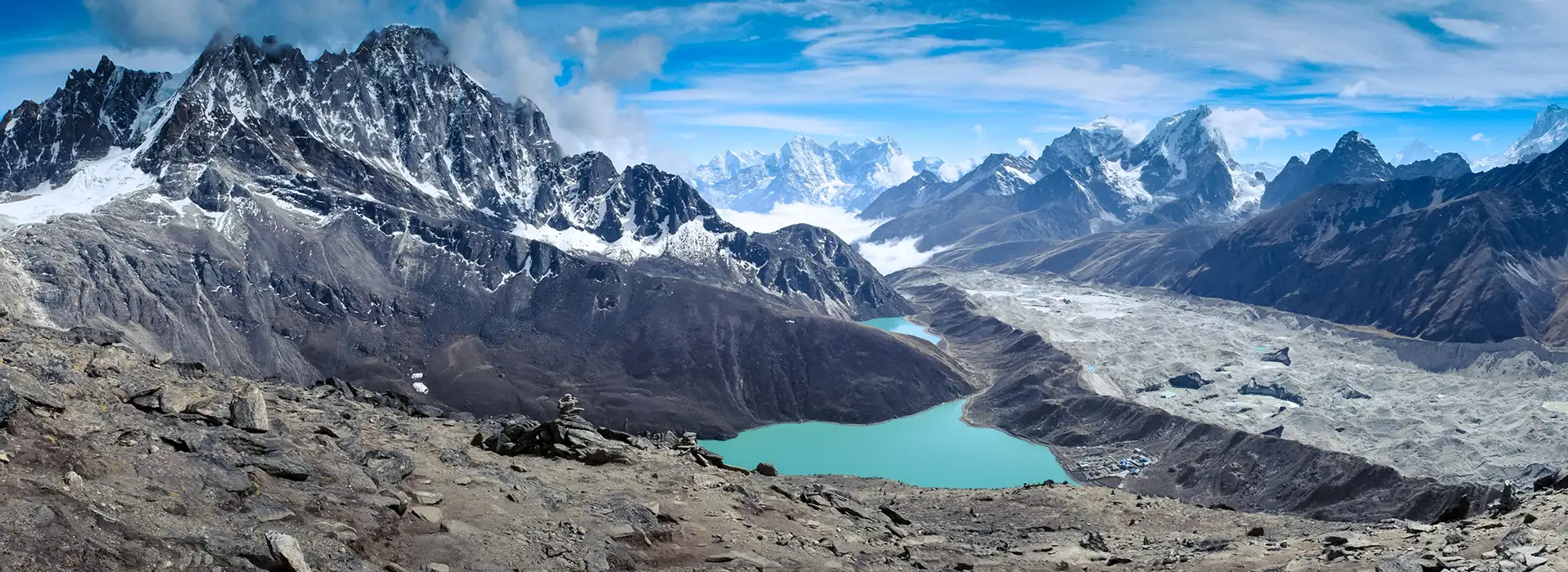
The Gokyo Lake Everest Base Camp Trek is a spectacular trek through the high Himalayas, offering a unique alternative to the traditional Everest Base Camp route. The trail passes through the pristine Gokyo Lakes, famous for their turquoise waters and incredible altitude. The trek takes travelers through the Dudh Koshi valley and continues into remote Himalayan landscapes, providing stunning mountain vistas and peaceful surroundings.
Along the route, trekkers encounter many Sherpa villages where they can experience local culture and traditions. Traditional stone houses, prayer flags, monasteries, and mani walls offer insight into Sherpa life at high altitudes. Staying in local teahouses allows travelers to enjoy home-cooked meals while interacting with the warm and welcoming Sherpa communities.
The Gokyo Lake Everest Base Camp Trek provides some of the most breathtaking Himalayan views. From viewpoints along the trail and the summit of Gokyo Ri, trekkers can see Mount Everest, Lhotse, Nuptse, Cho Oyu, and other towering peaks. Sunrise over Gokyo Ri is particularly stunning, offering an unforgettable perspective of the surrounding mountains and glaciers.
One of the highlights of the trek is crossing Cho La Pass, a challenging high-altitude pass that connects the Gokyo region with the original Everest Base Camp route. After the pass, trekkers reunite with the classic EBC trail, giving them a chance to experience both the Gokyo Lake area and the traditional Everest Base Camp trek.
The Gokyo Lakes are the highest freshwater lake system in the world, fed by the Ngozumpa Glacier, the longest glacier in the Himalayas. Trekkers can enjoy the calm and serene beauty of these lakes while capturing photographs of the turquoise waters reflecting the surrounding peaks. The lakes also hold spiritual significance for Hindus and Buddhists, adding a cultural element to the trek.
This trek is perfect for adventure seekers, trekkers, and anyone interested in Himalayan culture. It combines high-altitude trekking, Sherpa village experiences, glacial lakes, and summit views for a complete Himalayan adventure. The Gokyo Lake Everest Base Camp Trek is both physically rewarding and culturally enriching, making it a memorable experience in Nepal’s Everest region.

Included Meals

Trip staff

Transport

Accommodation
Teahosue

Trip Grade
Group Size
The itinerary includes acclimatization and rest days in Namche and Gokyo. We will go through the Sagarmatha National Park and the amazing villages and towns. The package consists of guides and porters as well. Prepare yourself for an unforgettable experience in the Everest region.
We will board an early morning flight from Kathmandu to Lukla. The 30-minute flight will pass through some of the best aerial views of the Himalayas. After landing, we will begin our trek right away. We will hike downhill for 3 to 4 hours along the Dudh Koshi Valley. We will pass pine trees and small villages and finally reach Phakding, where we will stay the night. Today’s short hike helps your body begin adjusting to the altitude.
Difficulty
We will eat breakfast in Phakding and start hiking toward Namche Bazaar. We will pass through rhododendrons and cross suspension bridges. The Hillary Suspension Bridge is one of the most popular suspension bridges in the area.
After crossing it, we will shortly reach Monjo and go to Sagarmatha National Park. We need to show our permits there to proceed further. After this, the trail is steep, mainly uphill. We will gain about 800m in altitude today.
Midway, we will get our first glimpse of Mt. Everest. Continuing the hike, we will reach Namche Bazar by early afternoon. We will spend the night there, enjoying views of Kongde Ri and Thamserku.
Difficulty
We will not continue the hike today. It is an acclimatization day. We will let our bodies adjust to the changing altitudes.
We will take a brief hike to the Everest View Hotel or the Sagarmatha National Park Museum. We can see Everest, Ama Dablam, Lhotse, and other peaks from these points. We will return to Namche for lunch and rest for the rest of the day.
Travelers can either relax or explore the beautiful Sherpa village. We can visit different bakeries, cafés, shops, and teahouses. We will stay the night and prepare for our hike tomorrow.
Difficulty
Our hike starts from Namche towards Dole. The classic Everest Base Camp Trek follows the trail to Tengboche, and we will leave the main trail and start making our way to Dole.
We will walk along a beautiful hillside with the views of Ama Dablam and even a distant view of Everest. We will walk through rhododendrons and Himalayan junipers. We will reach Mong La Pass at 3,970m after walking for about 2 hours. Mong La has a stupa at the top, where we will take a break to enjoy the views of the Khumbu Valley.
Then, we will walk down towards Phortse Thenga, where we will have lunch and start the hike again. We get to the forests of fir and rhododendrons in the afternoon.
We will walk till the end of the tree line and reach Dole. Today, we walked for 6 to 7 hours. By now, the thinning air and colder temperatures begin to take a toll on the body.
Difficulty
We will continue the hike in the morning. The trial is uphill primarily, following through high alpine meadows where yaks graze in the summer.
After gaining altitude, we will pass through Lhabarma and Luza and see Cho Oyu. We will walk for about 4 hours until we reach Machhermo from Dole. Machhermo is a peaceful little village in a wide mountain valley surrounded by snow-covered peaks.
If available, you can catch a helpful talk on altitude sickness at the local rescue post. We wind down in the evening and spend the night in a cozy teahouse.
Difficulty
We will leave Macchermo and get to its high point, where we will enjoy the views of Kangtega and Thamserku. We walk on a gentler trail towards Ngozumpa Glacier. It is also the longest glacier in Nepal.
We will pass through its moraine and see the first Gokyo Lake. The Gokyo Lakes are deep turquoise, standing out against the barren ground. Then, we will pass through the second and third lake, Dudh Pokhari. The Gokyo village lies here on its shore.
We will reach there by midday and have the rest of the day to enjoy and rest. You can explore the lakeshore or hike a nearby ridge for panoramic views.
We will spend a night at one of the highest settlements in the world, Gokyo.
Difficulty
Gokyo will serve as our next acclimatization spot. Here, we will rest our bodies to adjust to the steadily increasing altitudes.
We are already almost at 5000m, so it is essential that our bodies can handle the altitude. We will take a short hike to Gokyo Ri before dawn. Reaching the summit before sunrise takes about two hours of steady uphill hiking. We will enjoy the beautiful sunrise over the Himalayas.
We can see Everest, Lhotse, Makalu, Cho Oyu, and other peaks here. We will then return to our lodge for a late breakfast.
We can even hike to the fourth or fifth of the Gokyo Lakes if our bodies allow us to. We must hydrate and rest our bodies well to adjust to this high altitude.
We will sleep well for the night and prepare for tomorrow.
Difficulty
Today’s trek is only about 3 to 4 hours long. We will cross the Ngozumpa Glacier by walking on its uneven rocky path.
We will climb a short ascent and reach Thangnak, or Dragnang. It’s a small settlement with limited lodging options. We will get to our destination for the day by lunchtime.
We will spend the rest of the day preparing for a long hike tomorrow.
Difficulty
We start the day very early, often before sunrise, with headlamps lighting the way as we begin the steep climb to Cho La Pass.
The trail gains over 700 meters and winds through rocky terrain, sometimes with snow or ice, so we go slowly and take breaks as needed. Reaching the top of the pass at 5420 meters is a significant milestone. Prayer flags mark the high point.
After soaking it in, we begin the steep descent, which can be slippery, especially in colder months. Once past the tricky section, the trail flattens out as we walk through a quiet valley lined with glacial moraines.
By early afternoon, we reach Dzongla, a small settlement with just a few lodges. Surrounded by peaks like Cholatse and Lobuche, it is a peaceful and rugged place to rest after a long and rewarding day.
Difficulty
After the challenge of yesterday, today feels more relaxed. We set off later and walked along gentle hills, passing grazing yaks and small streams.
After a few hours, we arrive at Dughla, a small place with a few tea shops where trails from Pheriche and Dingboche meet. From here, we steadily climb to the Dughla Pass, where memorials honor climbers who lost their lives on Everest. It’s a quiet and moving place. The trail then flattens out as we follow the edge of the Khumbu Glacier to Lobuche.
We usually arrive by lunch, giving us time to rest and adjust. The surroundings feel remote and wild, and the temperature drops quickly in the evening.
We settle into our lodge in Lobuche, now very close to Everest Base Camp.
Difficulty
We will be reaching Everest Base Camp today. After an early break, we still start walking towards Gorakshep. We will walk for about 3 hours, following rocky trails and high-altitude flats. We will go through the Khumbu Glacier moraine and see the views of Pumori and Nuptse. Gorakshep is our last spot before Everest Base Camp.
We will check in at our lodge there. We will eat and leave our bags there. Then, we will walk towards Everest Base Camp in the early afternoon. Reaching Everest Base Camp takes about 2 to 3 hours from Gorakshep. We will again walk through rocky paths and moraine.
Finally, we will get to the Base camp at 5,364m. After celebrating our win, we will head back to Gorakshep and stay the night there. Total hiking hours today would be 7 to 8 hours. Rest early to recharge your body from the exhausting day.
Difficulty
Our trek starts early, before dawn today. We will hike up from Gorakshep towards Kala Patthar, a famous viewpoint.
We will climb the steep for about 2 hours until we reach Kala Patthar during sunrise. Kala Patthar summit at 5545m is also the highest point of our trek. We will see the beautiful sunrise hitting the Himalayan Mountains from there. We will see Everest, Nuptse, Changtse, Lingtren, and Pumori. We can also see the Everest Base Camp and Khumbu Glacier, which are far below.
Then, we will head back to Gorakshep again for breakfast. After packing up, we will start our descent.
We will walk past Lobuche and Dughla. The altitude gradually decreases, making the trek easier. We won’t stop at Dingboche. Instead, we will walk further and end the day in Pheriche at 4,240m. The altitude drops by more than 1,300m.
The hike lasts for about 6 hours from Gorakshep. We’ll rest and recover for the trek ahead.
Difficulty
Today, we will join the main route from Pheriche. We will walk on the trails towards Pangboche and Tengboche. Our trek will go through rhododendron forests and small villages. We walk through Pangboche, passing one of the highest year-round settlements.
The trail drops from Pangboche to the Dudh Koshi River, then climbs to Tengboche. We will stop at Tengboche, where we’ll eat lunch, then start the trek again. We can visit the ancient monastery there.
We will descend from Tengboche with the views of Ama Dablam to Phukti Tenga. From there, we will climb towards Kyangjuma and finally reach Namche Bazaar.
Today’s walk was 6 to 7 hours in total. The air is way thicker here, and the lodges are vibrant. We can take hot showers and celebrate the long day.
Difficulty
Today will be our final day in the Khumbu Valley. We will start the hike from Namche and descend towards Dudh Koshi, crossing the suspension bridges and exiting the Sagarmatha National Park.
We will reach the village of Monjo and walk across the familiar town. Continuing through Phakding, we’ll have lunch there, then walk towards Lukla. There is a final short uphill after which we will reach Lukla. It’s a 7-hour, challenging but rewarding trek.
We will check in at our lodge, celebrate with the team, stay the night, and prepare for the next day.
Difficulty
Today, we woke up early and boarded our flight to Kathmandu. The 30-minute flight offers great aerial views of the Himalayas.
We will reach Kathmandu, transport it back to our hotel, and arrange the day. We can go shopping and sightseeing as well. Today marks the official ending point of our Gokyo Lake Everest Base Camp trek. Reflect on your trip and enjoy your day.
We recommend an extra day or two in your schedule for any possible delays in the trip.
Difficulty
Documents and Money: Passport, Nepal visa, passport-sized photos, and travel insurance information. Photocopies of the documents for backup. NPR cash for the trek. Credit cards won’t work on the trek.
Building your fitness step by step is a good idea to prepare for your trek. Aim for regular cardio like hiking, jogging, cycling, or swimming a few times a week for about thirty to sixty minutes.
If you can, go on practice hikes using the boots and backpack you plan to bring so your body gets used to the gear and uneven trails.
Adding simple strength exercises like squats, lunges, and planks will help build your leg and core strength. Try including stair climbing or hills to prepare for the uphill sections. Increase the length and difficulty of your hikes gradually to avoid injury, and work up to walking five to six hours a day. The key is staying consistent. Regular moderate training will go a long way in making your trek feel easier and more enjoyable.
Traveling at elevations above 5000m imposes the risk of AMS on our bodies. Acute Mountain Sickness (AMS) is altitude sickness in simple terms.
Our itinerary includes acclimatization days to minimize the risk of altitude sickness. Common symptoms of AMS include headache, dizziness, loss of appetite, sleep loss, and nausea. Knowing and detecting these symptoms is essential so you can avoid further problems.
We strictly follow the “Climb high, sleep low” rule, which limits the daily altitude gain. We will also hike to higher elevations and fall asleep during acclimatization days.
Avoid alcohol and smoking. Staying well-hydrated is essential for acclimatization. If you’re feeling off or showing signs of altitude sickness, speak to your guide immediately so they can support you quickly.
Before your trip, check in with your doctor to discuss needed medications. Many trekkers take Diamox, but it’s best to see if it’s right for you. Taking things slow and giving your body time to adjust is one of the best ways to stay safe and enjoy your time in the mountains.
Most nationals require a tourist visa to enter Nepal. You can get a Visa upon arrival at Tribhuwan International Airport.
You can fill out an online form or at the Airport. Present a valid passport with at least six months’ validity and a passport-size photo. You can pay the fees in USD or NPR. A 30-day visa is enough for the Gokyo Lake Everest Base Camp trek.
You can also acquire a visa from the Nepal embassy in your home country before arrival. Both ways are accepted and relatively easy. Our team will assist you with visas and trekking permits. We will handle these permits after your arrival.
The package includes the cost of these permits. Bring extra ID photos and cash if needed. With your visa and permits, you’ll be all set to trek.
Nepal’s currency is the Nepalese Rupee (NPR). You can get cash or exchange money in Kathmandu and Namche, but there are no ATMs after that. Carrying enough rupees for snacks, water, hot showers, device charging, or Wi-Fi is a good idea. Prices increase as you climb higher, so a little extra goes a long way.
The trek package covers most of your meals and stay. You’ll need some cash for small extras or tips for your guide and porter.
Nepal is generally affordable, but having some backup money is always smart in the mountains.
The local people of the Everest region are the Sherpa people. It is essential to respect the culture of the place we are visiting.
We require our clients to have a mandatory travel insurance plan. We advise buying the plan that covers high-altitude trekking up to 5,600m. Make sure it includes an emergency medical helicopter evacuation.
Without insurance, these evacuations can cost thousands of dollars. Pick the package that also covers medical treatment costs, trip cancellation, and loss of belongings. Please provide us with your insurance details before the trek starts.
We need this to coordinate a rescue if anything happens. When choosing insurance, make sure it covers trekking at high altitudes. Some policies have limits, so check that they include Everest Base Camp.
It’s best to look for plans designed for hiking or adventure travel. Having the right insurance means you can enjoy the trek with peace of mind, knowing you’re covered if anything unexpected happens.
We also offer several optional add-ons if you want.