
Included Meals
- Breakfast: 14
- Lunch: 14
- Dinner: 13

Unbeatable Holiday Offers – Save Up to 20% on Your Next Adventure!
The Langtang Gosaikunda Trek is a two-week journey through the heart of the Himalayas, blending natural beauty with spiritual and cultural experiences. Trekkers move from the lush forests and river valleys of Langtang National Park into dramatic high-altitude terrain, surrounded by towering peaks. Along the trail, they walk through pine and rhododendron forests, cross sparkling streams, and pass serene alpine pastures.
The trek provides breathtaking views of Langtang Lirung, Dorje Lakpa, and other Himalayan giants. Travelers explore historic monasteries, including Kyanjin Gompa, and witness yak pastures and glacier viewpoints rebuilt after the 2015 earthquake, offering a mix of culture, history, and scenic beauty.
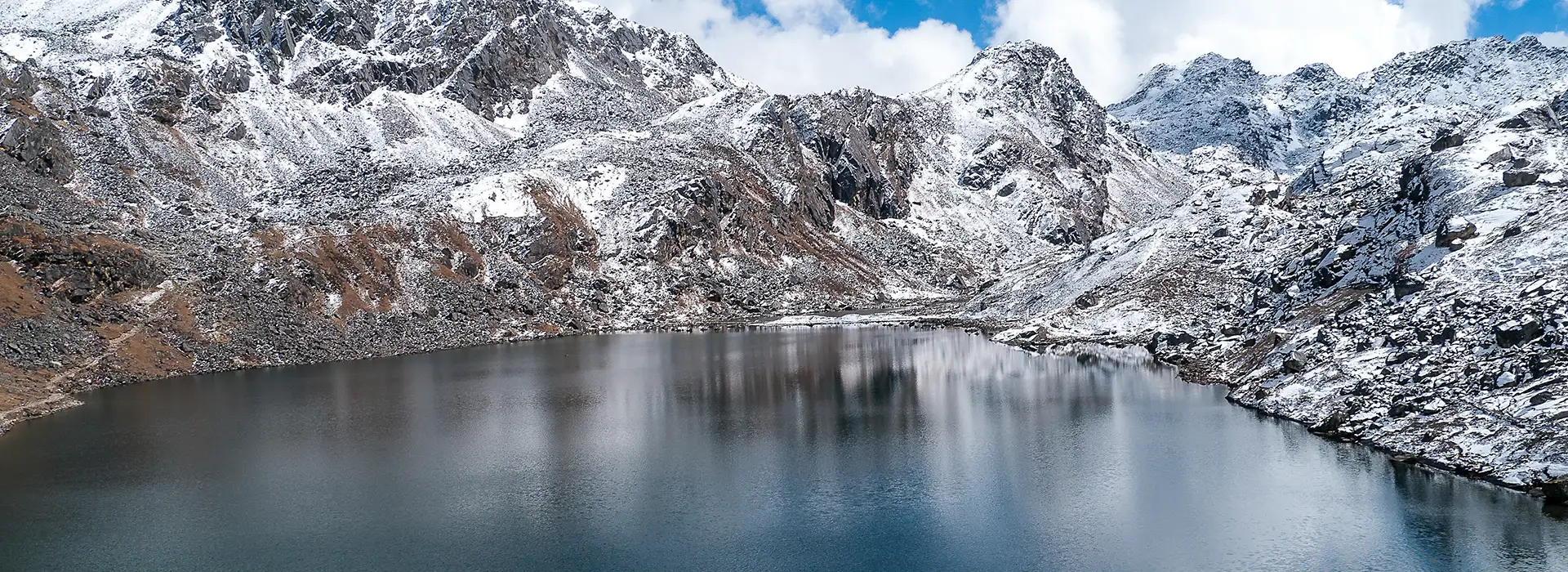
The trail then leads to Gosaikunda Lake, a cluster of sacred glacial lakes above 4,300 meters. Pilgrims and trekkers alike are drawn to this spiritual sanctuary, believed to be protected by Lord Shiva. The lake sits amid stunning alpine peaks, creating a breathtaking panoramic setting.
Trekkers then cross the high Lauribina La Pass at 4,610 meters, experiencing sweeping Himalayan views along the way. The route gradually descends through the Helambu region, showcasing terraced fields, traditional villages, and colorful monasteries before finishing near Sundarijal on the outskirts of Kathmandu Valley.
The Langtang Gosaikunda Trek maintains a moderately challenging pace, with daily hikes of 4 to 7 hours. Gradual climbs and high-altitude crossings make the trek suitable for fit beginners as well as experienced trekkers. Spring offers vibrant rhododendron blooms, while autumn provides the clearest skies and the most stunning mountain vistas.
With a carefully planned itinerary, experienced guides, and cozy accommodations, the trek delivers a fulfilling, unforgettable Himalayan adventure that combines nature, culture, and spirituality.

Included Meals

Trip staff

Transport

Accommodation

Trip Grade
Group Size
The Langtang Gosaikunda trek begins with a 7 to 8-hour drive from Kathmandu (1,400m) to Syabrubesi (1,503m). This 120 km drive takes you through mountain roads, terraced hillsides, and rural settlements. We will pick you up from your hotel in the early morning and begin the road drive. Manaslu, Ganesh Himal, and the Langtang range are visible from the drive on clear days.
After crossing Trishuli Bazaar, the road becomes rougher as it climbs to Dhunche, the gateway to Langtang National Park. Then, after a short descent, the drive will take you to Syabrubesi, a small riverside village. Check into your local teahouse and rest for the evening. You can take a short walk through the town, review your gear, and enjoy a quiet evening.
Elevation: Kathmandu (1,400 m) → Syabrubesi (1,503 m)
Elevation Gain & Oxygen: +103 m gain, ~84% oxygen level at Syabrubesi
Distance & Drive Duration: ~120 km (7–8 hours)
Landmarks Passed: Trishuli River, Trishuli Bazaar, Dhunche, Langtang National Park Entry
Accommodation: Teahouse in Syabrubesi
Meals Included: Breakfast, Lunch, Dinner
Meals Breakfast, Lunch, Dinner
Difficulty
The trek begins today. Have breakfast in Syabrubesi, then cross a suspension bridge over Bhote Koshi and follow the Langtang Khola upstream. The trail goes east towards the subtropical forest and ascends steadily through steeper sections. You will cross many suspension bridges as the path zigzags the river.
You’ll pass small settlements like Pairo and Bamboo, where you will stop for tea or lunch. These dense bamboo forests are popular for occasional red panda sightings, with some langur monkey and birdlife sightings. The forest shifts to oak and rhododendron as the elevation increases. You will reach Lama Hotel (2,470m) after hiking for about 5 hours. Lama Hotel is a peaceful cluster of houses near the river valley. Settle in your lodge and rest early.
Elevation: Syabrubesi (1,503 m) → Lama Hotel (2,470 m)
Elevation Gain & Oxygen: +967 m gain, ~73% oxygen level at Lama Hotel
Distance & Trek Duration: ~6 km (4–5 hours)
Trail Type: Forested River valley, steady ascent with occasional steep sections
Landmarks Passed: Pairo, Bamboo, Langtang Khola, multiple suspension bridges
Accommodation: Teahouse in Lama Hotel
Meals Breakfast, Lunch, Dinner
Difficulty
Continue ascending along the Langtang Khola after an early breakfast. You will climb through oak and rhododendron forests with occasional glimpses of the mountains towering over you. After hiking for a few hours, you reach Ghodatabela (~3,030m), which means “Horse Stable”. The forest thins out and transitions into open alpine terrain, offering a wide view across the valley. It is a good place for lunch and rest.
The landscape opens up further after crossing Ghodatabela. You will pass through areas destroyed by the 2015 earthquake, with large boulders and remnants of damaged settlements making it. After about 6 hours of trekking over roughly 10 km, you will reach Langtang Valley (3,430m). The local government recently rebuilt the Langtang Valley with stone houses, newer lodges, a small monastery, and a local cheese factory. Settle into your teahouse and enjoy a warm dinner with a view of towering Langtang Lirung (7,227 m). You can notice the Tibetan Buddhist heritage of the region through the prayer wheels and mani walls leading up to the valley.
Elevation: Lama Hotel (2,470 m) → Langtang Village (3,430 m)
Elevation Gain & Oxygen: +960 m gain, ~64% oxygen level at Langtang Village
Distance & Trek Duration: ~10 km (5–6 hours)
Trail Type: Gradual forested ascent, transitioning to alpine meadows
Landmarks Passed: Ghodatabela, earthquake-affected zone, mani walls, Langtang Khola
Accommodation: Teahouse in Langtang Village
Meals Breakfast, Lunch, Dinner
Difficulty
The trek’s shorter today, giving you time to acclimate and explore. You will gently climb towards Kyanjin Gompa. The trek covers about 7 km in about 5 hours at a leisurely pace while passing through vast yak pastures and open alpine terrain with limited vegetation.
Along the way, you’ll see yak herders using the traditional stone hits and crossing mountain streams on wooden bridges. The trail continues through prayer glass, chortens, and mani walls with surrounding peaks approaching you.
You will arrive at Kyanjin Gompa (3,865m) by midday. This village is the last permanent settlement in the valley and sits beneath the towering mountains, with the historic Kyanjin Gompa at its center. Visit the monastery and the local cheese factory to sample fresh yak cheese. Alternatively, you can take a short acclimatization hike to Langshisha Kharka to view the expansive valley. You can also hike partway up to Kyanjin Ri for a close-up of Langtang Lirung’s glaciers. Have a warm meal in your lodge and rest beneath the mountains.
Elevation: Langtang Village (3,430 m) → Kyanjin Gompa (3,865 m)
Elevation Gain & Oxygen: +435 m gain, ~61% oxygen level at Kyanjin Gompa
Distance & Trek Duration: ~7 km (4–5 hours)
Trail Type: Gentle alpine ascent through yak pastures and glacial terrain
Landmarks Passed: Herders’ huts, prayer flags, chortens, Langtang Lirung views
Accommodation: Teahouse in Kyanjin Gompa
Meals Breakfast, Lunch, Dinner
Difficulty
Wake up pre-dawn for a beautiful sunrise over the Langtang peaks and begin your return down the valley. Hike through the familiar trail and pass Langtang Village, then continue beyond Ghodatabela.
You will cover about 18km today while descending, making it gentler on your lungs compared to uphill hiking. You should trek at a steady and comfortable pace to avoid overexertion. You will cover the two days of uphill climb in just one day while descending. Use trekking poles for improved balance and knee support.
Enjoy the lush forest, mountain streams, and the sound of the Langtang Khola flowing after trekking for about 6 to 7 hours. You will arrive back at Lama Hotel (2,470m). Enjoy a hot meal and rest in the familiar riverside lodge.
Elevation: Kyanjin Gompa (3,865 m) → Lama Hotel (2,470 m)
Elevation Loss & Oxygen: –1,395 m descent, ~73% oxygen level at Lama Hotel
Distance & Trek Duration: ~18 km (6–7 hours)
Trail Type: Mostly downhill on forested and alpine trails
Landmarks Passed: Langtang Village, Ghodatabela, Langtang Khola
Accommodation: Teahouse in Lama Hotel
Meals Breakfast, Lunch, Dinner
Difficulty
Today, you’ll leave the Langtang trail and enter the Gosaikunda region. The trail descends through the forest along the Langtang Khola. You will reach the junction at Pairo after a few hours, which you passed on Day 2. A bridge leads you to a continuous trek towards Thulo Syabru from this junction.
Then, the trail climbs steeply through terraced farmlands, hillside forests, and many Tamang hamlets. The climb is challenging but worthwhile with the views of Langtang Himal and Ganesh Himal. After trekking for about 8 hours, you will reach the village by early afternoon.
Thulo Syabru (2,230m) is a well-known hillside settlement famous for its rich Tamang traditions and unique architectural style. You can explore the local monastery and chortens, walk along the stone paths, while enjoying the warm hospitality of the local teahouses.
Elevation: Lama Hotel (2,470 m) → Thulo Syabru (2,230 m)
Elevation Loss & Oxygen: –240 m net loss (with steep ascent), ~76% oxygen level at Thulo Syabru
Distance & Trek Duration: ~6–7 km (5 hours)
Trail Type: Forested descent, then steep uphill through terraced hills and villages
Landmarks Passed: Pairo junction, Tamang settlements, Langtang Khola
Accommodation: Teahouse in Thulo Syabru
Meals Breakfast, Lunch, Dinner
Difficulty
Begin a steady ascent towards Sing Gompa after breakfast in Thulo Syabru. The distance is short, but the significant altitude change makes the trek hard.
Begin the trek with a steep ascent through dense pine and rhododendron forest. These forests are full of colors during spring. As you gain elevation, close-up views of the Ganesh Himal and distant Annapurna range start coming into view. After about 3 hours of continuous ascent, you will reach the peaceful village of Sing Gompa. At 3,250m, this settlement is known for its historic Buddhist monastery and a government-run cheese factory. It is a perfect blend of spiritual and rural Himalayan life.
You will arrive by midday with plenty of time to rest and explore the village. Visit the gompa, observe the daily rituals, and taste a sample of fresh yak cheese. End the day with a warm meal and beautiful sunset views.
Elevation: Thulo Syabru (2,230 m) → Sing Gompa (3,250 m)
Elevation Gain & Oxygen: +1,020 m gain, ~67% oxygen level at Sing Gompa
Distance & Trek Duration: ~5 km (2–3 hours)
Trail Type: Steep forested ascent through pine and rhododendron woods
Landmarks Passed: Himalayan viewpoints, Buddhist monastery, yak cheese factory
Accommodation: Teahouse in Sing Gompa
Meals Breakfast, Lunch, Dinner
Difficulty
Leave Sing Gompa and climb the trail above the tree line that opens into an open alpine terrain. The path ascends steadily through limited, scrubby vegetation and naked hillsides. The name “Lauribina” literally translates to “without a stick” in Nepali, suggesting the trail’s steepness. Use your trekking poles for balance and knee support.
Today, you cross a high-altitude section, so take it slow at a steady pace. The mountains start towering above you at a very close-up distance. If the day is clear, you can see the Langtang range, Ganesh Himal, Manaslu, and even the Annapurna range in the distance.
You will arrive in Lauribina Yak (4,610m) by early afternoon. This remote ridgeline settlement has a few basic teahouses and is a popular acclimatization stop for the Gosaikunda trek. Today’s trek takes about 4 to 5 hours and covers 7-9 km. Rest well in your lodge and enjoy the sunset across the mountains and deep valleys. Drink hot fluids and layer up since the nights are freezing here.
Elevation: Sing Gompa (3,250 m) → Lauribina Yak (4,610 m)
Elevation Gain & Oxygen: +1,360 m gain, ~58% oxygen level at Lauribina Yak
Distance & Trek Duration: ~7–9 km (4–5 hours)
Trail Type: Steep alpine ascent through open hillside and scrub
Landmarks Passed: Panoramic viewpoints of Langtang, Ganesh, Manaslu, and Annapurna ranges
Accommodation: Teahouse in Lauribinayak
Meals Breakfast, Lunch, Dinner
Difficulty
Set out for one of the trek highlights to the sacred lakes of Gosaikunda after breakfast today. Today’s trek is less demanding than yesterday’s as it only covers about 6-8 km in about 4 hours.
You will hike through gentle ascents and descents across barren, rocky slopes along the alpine vegetation. Keep your camera or phone handy; the trail is picturesque and beautiful. First, you will pass small holy lakes like Saraswoti Kund and Bhairav Kund, essential in Hindu and Buddhist traditions.
Finally, you will arrive at Gosaikunda Lake (4,380m), the largest and most sacred lake. It lies beneath the giant mountain peaks and is a famous pilgrimage site. Every year in August, devotees worldwide gather here for the Janai Purnima festival.
The lake has a profoundly spiritual and serene atmosphere even outside festival times. The crystal blue lake has a shrine dedicated to Lord Shiva and stones bordering it.
Settle into your teahouse by the lake and enjoy the peaceful afternoon. You can walk along the lake, visit small temples, or take in the energy from the lake. On clear nights, stars reflect on the water, making it look breathtaking. Rest and eat a hot meal at night to fuel the body.
Elevation: Lauribina Yak (4,610 m) → Gosaikunda Lake (4,380 m)
Elevation Loss & Oxygen: –230 m descent, ~61% oxygen level at Gosaikunda
Distance & Trek Duration: ~6–8 km (4 hours)
Trail Type: Rocky alpine terrain with some gentle ups and downs
Landmarks Passed: Saraswoti Kund, Bhairav Kund, Gosaikunda Lake, Shiva shrine
Accommodation: Teahouse near Gosaikunda Lake
Meals Breakfast, Lunch, Dinner
Difficulty
Today is the most challenging day of the trek. You will cross the trek’s highest point, Lauribina Pass or the Lauri Kund Pass. Start your trek early while gradually ascending towards the pass. The trail is rocky with some patches of snow depending on the season, so mind your legs.
After hiking for about 2 hours, you will reach the summit of Lauribina Pass at 4,610m. You can pause here to celebrate your achievement among the prayer flags and cairns. Enjoy the 360° mountain panorama from the summit. You will see Langtang behind you and Ganesh Himal over the horizon. If the day is clear, you might even see the Rolwaling and Everest ranges in the distance.
After taking in your achievement, begin descending towards Ghote. The terrain is rugged and, in some sections, steep. You will pass a few small settlements at Phedi, the base of the pass, where you can rest and eat lunch. Continue through the trail after lunch via some rocky sections before reaching the forested paths where you’ll lose altitude.
After trekking for about 5-6 hours and covering 7-9 km, you will reach Ghopte (3,440m), a small secluded settlement at the forest clearing. “Ghopte” translates to “hidden” in Nepali and offers a peaceful setting. Enjoy your dinner and rest early to recover.
Elevation: Gosaikunda Lake (4,380 m) → Lauribina Pass (4,610 m) → Ghopte (3,440 m)
Elevation Gain & Loss: +230 m gain, –1,170 m descent
Oxygen Level at Ghopte: ~69% of sea level
Distance & Trek Duration: ~7–9 km (5–6 hours)
Trail Type: Rocky alpine ascent, steep descent through rugged terrain, then forested path
Landmarks Passed: Lauribina Pass, Phedi teahouses, forested descent
Accommodation: Teahouse in Ghopte
Meals Breakfast, Lunch, Dinner
Difficulty
Today’s trek is shorter and gentler than yesterday’s. The trail from Ghopte to Tharepati passes through a forested ridge with gentle ups and downs, making the hike easier. Begin the trek through forests of rhododendron, pine, and juniper with distant sounds of birds echoing through the trees.
After about 3 hours of hiking through cool and crisp mountain air, you will reach Tharepati (3,640m), a beautiful ridge-top settlement with few lodges. On a gentle trail, you covered about 9 km in about 3 to 5 hours. Tharepati offers a viewpoint over the Helambu region, the Langtang range in the north, and the lush green Kathmandu valley in the south. You can spot the Everest region in the far east if the day is clear.
Since you’ll arrive early at your destination, you have plenty of time to explore, rest, and enjoy the place. Tharepati also serves as a trail junction with one route leading to Helambu villages and the next to Gosaikunda. You will continue south from here. Have a warm meal and rest early today.
Elevation: Ghopte (3,440 m) → Tharepati (3,640 m)
Elevation Gain: +200 m
Oxygen Level at Tharepati: ~66% of sea level
Distance & Trek Duration: ~9 km (4–5 hours)
Trail Type: Gradual ascents and descents along forested ridgelines with rhododendron/juniper
Landmarks Passed: Forested ridges, panoramic viewpoints of Langtang Himal/Helambu hills
Accommodation: Teahouse in Tharepati
Meals Breakfast, Lunch, Dinner
Difficulty
After breakfast, start your trek by descending into the Helambu region. The trail begins with a steep drop through dense rhododendron and oak forests. Since you will drop about 1,500m in elevation today, we recommend using a trekking pole to reduce pressure on your knees and to improve balance.
After a few hours of steady descent, you will start noticing the signs of local life return with terraced fields, traditional farmhouses, and cultivated lands. You will pass the village of Mangengoth, where you can stop for lunch or rest.
Continue trek through gentle ridgelines as the landscape shifts from towering mountains to lush green valleys and hills. After about 5 hours of trekking, you will arrive at Gul Bhanjyang, covering about 8-9km. Gul Bhanjyang is a beautiful mid-hill village home to the Tamang and Sherpa communities. Locals grow corn, potatoes, and vegetables in the terraces of their traditional homes.
The altitude is low, bringing warmer air and comfortable conditions. You can explore the village, have local tea, and enjoy the friendly hospitality.
Elevation: Tharepati (3,640 m) → Gul Bhanjyang (2,140 m)
Elevation Loss: –1,500 m
Oxygen Level at Gul Bhanjyang: ~82% of sea level
Distance & Trek Duration: ~8–9 km (5 hours)
Trail Type: Steep Forest descent followed by gentle ridgelines and village paths
Landmarks Passed: Rhododendron and oak forests, Mangengoth village, terraced farmland
Accommodation: Teahouse in Gul Bhanjyang
Meals Breakfast, Lunch, Dinner
Difficulty
Today is your final full trekking day. Leave Gul Bhanjyang and follow a ridgeline through forests and terraced farmlands. The trail goes up and down throughout the day. You will pass small hillside villages like Thodang Betini and Chipling, looking to rural Nepal.
As the path proceeds, you can see the Langtang mountains begging you and the Kathmandu valley on the southern horizon in front of you. Today’s trek is gentle and comfortable, covering only 7 to 8 km. You will reach Chisopani (2,134m), a quiet ridge-top village whose name translates to “Cold Water” in Nepali.
Chisopani is a popular location among the country’s population. If the day is clear, you can see the Annapurna ranges to the west and Everest in the east, your final views of these giant peaks. Chisopani also offers the views of Kathmandu Valley, signifying a return to civilization. Spend the afternoon enjoying the views and enjoy the warm farewell dinner in the teahouse with your guides and porters.
Elevation: Gul Bhanjyang (2,140 m) → Chisopani (2,134 m)
Elevation Gain & Loss: Minor ups and downs, negligible net change
Oxygen Level at Chisopani: ~82% of sea level
Distance & Trek Duration: ~7–8 km (4–5 hours)
Trail Type: Gentle ridgeline walk through forest, farmland, and mid-hill villages
Landmarks Passed: Thodang Betini, Chipling, views of Langtang and Kathmandu Valley
Accommodation: Teahouse in Chisopani
Meals Breakfast, Lunch, Dinner
Difficulty
Wake up early for a sunrise view from Chisopani and begin your trek after breakfast towards Sundarijal.
The trail starts through peaceful forests of Shivapuri Nagarjun National Park, a conservation area home to rich biodiversity. You will pass the village of Mulkharka, then continue down the stone steps through dense forest and the Kathmandu water pipeline. The descent is steady, so use trekking poles for improved balance.
After hiking for about 5 to 6 hours and covering about 15 km, you will reach Sundarijal (1,400m). A private vehicle will be waiting for you at the edge of Kathmandu Valley. Fid farewell to your trekking team and board your vehicle. After about a 2-hour drive through the outskirts and suburban neighborhoods, you will return to Kathmandu. The car will drop you off at your hotel in the afternoon.
You can do anything you want for the rest of the day. You can take a hot shower, relax, or go souvenir shopping while exploring the city. Congratulations on successfully finishing your Langtang Gosaikunda Trek!
Elevation: Chisopani (2,134 m) → Sundarijal (1,400 m)
Elevation Gain & Loss: –734 m descent
Oxygen Level at Sundarijal: ~87% of sea level
Distance & Trek Duration: ~15 km (5–6 hours trekking), ~15 km (1–2 hours’ drive)
Trail Type: Forest descent with stone steps, pipeline path, and national park exits
Landmarks Passed: Mulkharka village, Shivapuri Nagarjun National Park, Sundarijal water system
Meals Breakfast, Lunch
Difficulty
The Langtang Gosaikunda trek is for those with a decent fitness level who enjoy walking. If you can walk for about 4 to 7 hours on some steep sections, you are fit enough for the trek. You don’t need prior trekking experience; you need stamina and a flexible mindset.
If you want an adventure through the Himalayas, without committing to longer treks like the Everest Base Camp, this trek is for you. You will finish your trek through the Langtang Valley and the Gosaikunda region in 14 days.
You can see snowy peaks, rivers from the glaciers, forests, and even wildlife like Himalayan Thar or red pandas. Not only is the trek rich in natural beauty, but you will also enjoy the vast cultural beauty of Nepal in the Tamang and Sherpa villages. Visit monasteries like Kyanjin Gompa, try local cheese, and learn the local culture. If these are what you like, you will love this trek.
The accommodation is simple in basic rooms, with hearty meals and shared bathrooms. You’ll fit right into the trek if you’re okay with not having luxury or finding the charm in the rustic local life. Facilities are better than camping, but don’t expect daily hot showers or heated rooms.
Trekking during spring and autumn is ideal for the Langtang Gosaikunda Trek. You will enjoy pleasant weather and vibrant landscapes if you like these seasons. The highest altitude is 4,610m at Lauribina Pass, offering a taste of high-altitude trekking without extreme exposure. It’s manageable with proper acclimatization. The trek is also great for solo trekkers, as travelers bond over meals and stories in teahouses. You can create more bonds and friendships while trekking.
This trek is a dream for photographers because of the beautiful landscape, portraits of locals, and sunrises over the Langtang Lirung. This is the perfect trek if you seek challenge, nature, culture, and reflection. Though it is not an easy trek, it is rewarding and accessible.
You’ll stay in traditional mountain lodges throughout the Langtang Gosaikunda Trek. These teahouses are family-run and straightforward, providing a basic yet cozy place to stay and hearty meals.
Rooms: You get a twin-sharing room with two single beds and a foam mattress, pillow, and blanket. Two trekkers will share one room unless anyone requests a single room. These teahouses fill quickly during peak seasons, so we book early where possible.
Facilities and Cleanliness: Most teahouses in Nepal don’t have a room heating facility. However, the dining hall has a communal stove warming the place. Guests share a bathroom with toilets ranging from Western to squat-style, often with a pour-flush system. Some teahouses provide basic solar or bucket hot showers with an extra NPR 200-500 fee. Cleanliness is decent. We advise carrying your sleeping bag, liner, toilet paper, and hand sanitizer.
Meals: The package includes all meals, breakfast, lunch, and dinner, while trekking. You’ll dine in the teahouse where you stay or at the lunch stop during the trek. The menu typically includes dal bhat, noodles, rice, momo, soup, pasta, and breakfast items like porridge, pancakes, and eggs. Food is simple and filling, perfect for the long hikes.
Drinks and snacks: You can buy tea, coffee, hot lemon, and snacks at teahouses. The prices increase as the altitude increases due to the scarcity of supplies. The package doesn’t cover these costs, so budget accordingly.
Electricity and Charging: Most teahouses generate power through solar or a generator, which run only during the evenings. Since electricity is limited, charging devices costs about NPR 200-500 per hour per device. You can bring a power bank or spare batteries.
WiFi and Network: Some lodges have limited WiFi for a fee, but the speed is low. You can use SIM cards for the mobile network in lower areas like Syabrubesi, which is spotty in higher zones. You can detox digitally and live in the moment while trekking.
Hygiene and water: Only drink filtered or boiled water to avoid water-borne diseases. You can also be your purification method. You can use wet wipes or quickly wash the whole trek, as the cold conditions don’t allow daily showers.
Hospitality: Teahouses lack luxury, but they offer warm hospitality to all. They will welcome you and share stories by the fire with other trekkers. The communal dining hall atmosphere is a highlight of trekking in the Himalayas of Nepal.
Accommodation in Kathmandu: While the package doesn’t include Kathmandu, we can arrange it for you. Communicate with us while booking, and we will arrange a hotel according to your preferences.
Room Upgrades: You can upgrade your teahouses in Syabrubesi or Langtang. Some teahouses offer attached bathrooms or slightly better facilities. Suppose you’d like an upgrade while trekking. Let us know in advance so we can arrange it, though it is subject to availability. Remember, “luxury” is still modest in these remote areas.
You need decent physical fitness and strong mental strength to finish this moderately challenging trek successfully. The hike ranges from 4 to 7 hours daily, often gaining or losing significant elevation. It is achievable for most people, but still challenging due to altitude, duration, and terrain.
Trekking Hours: You will be hiking for about 4 to 6 hours on average daily. Some days are shorter, to 3 to 4 hours, like the hike to Kyanjin Gompa or Sing Gompa, while some are longer, to 6 to 7 hours, like the descent to Lama Hotel. Our itinerary paces the trek steadily with regular breaks to make the trek achievable. Endurance is the key to these long trekking hours.
Distance and Terrain: You will cover more than 100km over the entire trek, with distances ranging from 6 to 15 km. Lower Sections like Syabrubesi to Lama Hotel have forest trails, stone steps, and riverside paths with many ups and downs. Mid-altitude sections like the trek from Lama Hotel to Kyanjin Gompa have moderate uphill climbs on well-defined and non-technical trails. The Lauribina Pass is the most challenging activity, with rocky and slippery trails. The Gosaikunda section involves steep ascents with rocky paths, switchbacks, and narrow stretches. Long downhill sprints are easier on the lungs but tough on the knees.
Altitude: Altitude is the primary concern for this trek. You begin trekking from around 1500m and reach the maximum of 4,610m at Lauribina Pass. You will notice shortness of breath, fatigue, or poor sleep after climbing above 3,500m, common reactions to thinner air. Our itinerary has built-in acclimatization days with gradual altitude gain to make the trek easier.
Technical Climbing: You don’t need any ropes, crampons, or mountaineering skills for this trek as it is a high-altitude mountain hike, not a technical climb. You might need micro spikes in early spring in case of snow.
Trail Conditions: Trails are well-established, with locals and trekkers frequently using them. Some first paths, stone staircases near villages, and occasional rocky or muddy patches exist. Your guide may take occasional detours in case of any landslides or other trail problems.
Mental and Physical Fitness: You don’t need an athletic build for the trek. You’ll be fine if you are usually active and can easily walk about 10km with a load. A strong mentality is equally as important as physical fitness in any trek. A good and flexible mindset will make the trek easier.
Thus, the trek is shorter than other treks and has similar difficulty, but not as remote or high. It is a culturally peaceful and less demanding trek than the Three Passes or other high-altitude treks. The Langtang Gosaikunda Trek is moderate with a few challenging parts, like altitude, which is unmanageable without correct preparation. Many trekkers say their time was tough, but the views made everything worth it. It is ideal for people who want to step up from their beginner trek in less extreme conditions.
You need some physical fitness for the trek. If you are already active, train your body for the trek about 2 weeks before the trek. But if you are inactive, we suggest beginning your trek preparation at least 3 months before.
Cardiovascular Endurance: Begin aerobic training 8 to 12 weeks before the trek. Do activities like hiking, jogging, or swimming to build stamina. Try 30-60 minutes of cardio 3 to 5 times each week. Stair climbs or uphill hikes stimulate trekking conditions.
Strength Training: Build the strength of your legs and core by doing exercises like lunges, step-ups, and planks. They help build muscle support for step ascents and descents, and help with balance on uneven trails.
Train with a Backpack: Go on a few practice hikes with a 5 to 7 kg backpack to get used to carrying your daypack. Wear your full gear to break in your boots, find your pace, and adjust to the physical demands of the trek. Gradually increase your walking distance on the weekends and aim to finish 10-15 km in one day. It helps build stamina for full trekking days.
Mental Preparation: Trekking is not just about physical fitness; you must also be mentally strong. Prepare yourself for cold weather and fewer facilities than you’re used to. You may face a chilly morning, simple accommodations, or physical fatigue. Knowing what to expect makes you more confident and resilient on the trail.
Pacing: Trekking is not a race. Our guides will maintain a steady, comfortable pace for altitude and group safety. While trekking, walking at a pace where you can still talk without being breathless is essential. Walk slowly but consistently to adjust well.
Acclimatization is the body’s adjustment to thinner air at higher altitudes. We have designed the itinerary with proper acclimatization to maximize your safety and comfort.
Key Acclimatization Principles: We follow the “Climb High, Sleep Low” principle for a successful trek. For example, on day 4, after trekking to Kyanjin Gompa, you will take an afternoon hike to Kyanjin Ri or Langshisha Kharka, then descend to sleep at Kyanjin Gompa. After reaching Lauribina Yak (4,610m), you will descend to sleep at Gosaikunda to avoid sleeping at the highest point. This strategy helps the body adjust and regulate oxygen levels and red blood cells.
Gradual Ascent: We carefully manage the elevation again, especially above 3,000m. It takes about three days to reach Kyanjin (3,865m) from Syabrubesi (1,503m), with an average 800-900m gain per day, with rest stops. Our itinerary includes a big descent back to Lama Hotel (2,470m) to refresh the body. Then you ascend gradually to Sing Gompa (3,250m) and Lauribina Yak (4,610m). For safe acclimatization, we avoid sudden elevation jumps exceeding 500m in sleeping altitude daily, except for Lauribina Yak.
Acclimatization Days: Some itinerary variations include a full rest day at Kyanjin Gompa. Our itinerary consists of a short acclimatization hike on day 4 and gradual altitude gain/loss to avoid risks of altitude sickness. We can add additional days for extra acclimation if necessary.
Guide Monitoring: Your guide will check for altitude symptoms daily, like headaches, nausea, appetite changes, or sleep problems. They carry pulse meters and monitor the oxygen level and saturation when necessary. If symptoms appear, they recommend preventive measures, like adjusting the pace, resting, or descending. They will follow the emergency protocol in case of serious problems like HAPE or HACE.
Key Safety Practices: You must never trek alone, especially in remote or forest areas. If you are taking a break, inform someone or take a company. If any domestic animals come your way, make way for them by standing on the hillside to avoid being pushed off the trail. In narrow paths, give way to the other group standing on the right side. Don’t approach any wildlife or feed any animals. Cross suspension bridges carefully and, if necessary, cross one person at a time. Avoid trekking after dark at all costs since the temperature is cold and visibility declines.
Hydration and Nutrition: Drink 3 to 4 liters of fluids daily, as dehydration worsens altitude sickness. Sip water or tea frequently throughout the day. Avoid alcohol and smoking, especially at higher altitudes, as they can cause dehydration and poor sleep and reduce oxygen intake, increasing the risks of altitude sickness. Eat balanced meals with high-carbohydrate foods like rice, lentils, pasta, and potatoes to fuel the body. Try eating something at every meal, even if you don’t like it.
Hygiene and Sun Protection: Use a hand sanitizer or wash your hands thoroughly before every meal. Use SPF30+ sunscreen, lip balm, hats, and sunglasses to prevent sunburn and snow blindness.
Emergency and Communication: If you feel any symptoms or discomfort, don’t hesitate to inform your guide. Guides carry mobile phones, walkie-talkies, or satellite phones for emergency contact and first aid. They have training in handling altitude sickness and other common trekking issues. They will make appropriate decisions in case of any emergencies.
Other: Some trekkers take Diamox to aid acclimatization. Consult your doctor before the trek about any medicine intake. You may have to descend as a result of altitude sickness. Carry rain gear and warm layers to prevent hypothermia since rapid weather changes are common.
Travel Insurance: Your travel insurance must cover trekking up to 5,000m and emergency evacuation. Carry emergency contact info and payment means for possible helicopter rescue.
Your safety and well-being are our top priority. You can increase your chances of a safe, rewarding, and unforgettable trek by following acclimatization protocols, staying alert, and communicating with your guide. Stay hydrated, walk comfortably, and respect the terrain and elevation.
We require mandatory travel insurance for all trekkers who trek with us. The Langtang Gosaikunda Trek involves trekking through remote trails, high elevations, and limited infrastructure, so travel insurance makes all the difference.
Your insurance should include high-altitude coverage. Confirm it covers trekking up to 5,000m. Many policies don’t cover high-altitude trekking or have lower altitude caps. The policy might require adding a specific adventure or mountaineering clause.
Emergency Helicopter Evacuation is essential. Helicopter rescue may be the only option in case of severe altitude sickness or injury. The cost of these evacuations ranges from $3000 to $5000, so your insurance must include this and outline the process for pre-approval. Helicopters require payments before flying, and hospitals often need payment guarantees. Our guides can assist with coordination in any emergencies.
Ensure your policy covers hospital visits in Nepal. Hospital treatments are expensive for foreigners in Nepal, so it is essential to have insurance to access good medical care in Kathmandu when necessary.
It is better if your insurance also covers trip cancellation or interruption. It protects you if you cancel at the last minute due to illness, injury, or family emergency. It also helps cover missed connections, delays, or early returns. Check if your policy includes loss or theft of baggage. Many have limits per item and don’t cover high-value electronics or cash. So, we recommend not bringing anything of great value.
Depending on where you live, companies like World Nomads, Allianz, IMG, or BUPA Global offer policies suitable for trekking in Nepal. Make sure your policy covers trekking up to 5,000 m in Nepal.
We at Peregrine Treks and Tours offer dedicated guides and porters to make the trek more enjoyable. They are the backbone of your trek and ensure your safety, enriching the trek.
Guide: A licensed, English-speaking guide will accompany you through the Langtang Gosaikunda Trek. They are certified by the Ministry of Tourism and the Trekking Agencies’ Association of Nepal (TAAN). They have years of experience in the Langtang region and are familiar with Nepal’s mountains and culture.
The guides know the trail and will lead you at a comfortable pace. They handle check-ins, arrange meals, and manage permits at checkpoints. Guides have training in first aid and Acute Mountain Sickness (AMS). They carry a first aid kit and watch out for your well-being. You can ask for help from your guide in any case.
While trekking, your guide will share fascinating stories on the region, mountains, wildlife, local culture, and history. These facts enrich your journey and teach you more about the area. Guides speak English and Nepali, with some speaking their native ethnic languages. They act as a bridge between you and the local people. Your guide will help you make all the decisions regarding the trail. Weather may cause the trail to be unsafe, so guides will reroute or delay your trek for your safety.
Beyond logistics, our guides are also friendly and kind. Many trekkers keep in contact with their guides even after many years due to their genuine bond. You will create great memories with your guides by sharing stories, laughs, and even card games in the evening.
Porters: You can trek with a light backpack since your porter will carry your luggage. Most of our porters are from the rural mountain region of Nepal, like Langtang, Solukhumbu, or others. They speak limited English and are warm and approachable.
A porter usually carries 10-25 kg in total. You can share one porter with another friend by distributing the weight of about 10-12.5 kg per person. Because of this, you will only carry your daypack with essentials like water, snacks, a jacket, a camera, and necessary documents/cash.
We ensure fair and responsible porter treatment and follow the International Porter Protection Group (IPPG) ethics guidelines. Porters get fair wages, a reasonable weight limit, nutritious meals, and decent lodging. We also provide them with proper gear like warm clothing, shoes, sunglasses, and travel insurance.
Tipping is customary at the end of the trek to show appreciation for the team. We will provide a tipping guideline before the trek during the briefing. Without guides leading the trek and porters carrying your load, your trek is much easier and memorable. Our team is your companions and protectors during the trek.
You are not just trekking through the mountains in Nepal; you are also visiting the remote cultural villages of Nepal. The trail passes through Tamang, Sherpa, and Yolmo communities, with Tibetan Buddhism influence throughout the region.
You can say “Namaste” to greet the local people by joining your hands in a prayer pose while slightly bowing with a smile to greet people. In Tibetan-speaking areas, you can say “Tashi Delek”. Both are warm and respectful ways to connect with people.
While trekking clothes are fine, you should dress modestly in villages and monasteries. Avoid shorts or revealing tops and remove your hats, sunglasses, and shoes when entering sacred places. Walk clockwise in the monasteries around stupas and mani walls. Ask before clicking pictures inside the holy sites and of people. You can donate small amounts to the monasteries.
Don’t point your feet toward people or altars or touch anybody’s head. Spin prayer wheels clockwise and never touch or step over the sacred texts or mani stones.
Bing snacks or handicrafts, the tea houses support the village economy. Avoid leaving trash, batteries, or plastic behind and carry out what you can. By translating for you, your guide will act as a bridge between you and the local people.
Nepalese people are known for their warm and tolerant personalities, but you must not exploit them. Follow the cultural tips for mutual respect.
You should pack smartly to prepare for any weather and conditions. Pack in layers and light so it is easier for you and your porter to carry.
Clothing: Your base layers should be quick-dry t-shirts or long-sleeved shirts with mid layers of fleece or a light down jacket. Pack a waterproof/windproof or rain jacket for an outer shell. You need trekking pants plus thermal leggings or fleece pants for cold nights. Pack waterproof pants or poncho for rain protection, a warm hat, sun cap, buff or scarf, and lightweight/warm gloves for accessories.
Footwear: You need sturdy, broken-in trekking boots with good ankle support. Pack moisture-wicking socks, warm wool socks, and camp shoes or sandals for evenings at the teahouse.
Trekking Gear: You need a 25-30L daypack with a rain cover, UV-protected sunglasses, a headlamp with extra batteries, and trekking poles. Bring 1 or 2 water bottles or a hydration bladder with purification tablets and filters for safe drinking water.
Sleeping gear and Personal items: Even though teahouses provide blankets, they might not always be enough. Bring a 4-season sleeping bag, quick-dry towel, basic toiletries, sunscreen, SPF lip balm, and a small first aid kit. You should bring enough personal medication, Diamox, and blister care. Other essentials included hand sanitizer, wet wipes, and a toilet roll. Take a few of your favorite energy bars to snack on during long trekking days.
Documents and Money: Carry your passport, visa papers, trekking permits, and travel insurance documents with a few photocopies. Since no ATMs are in the trail and lodges or shops don’t accept credit cards, bring Nepali cash in small denominations.
Extra: Bring your camera or smartphone for photos, a travel adapter for Type C or D outlets for 220V, and a portable power bank. If you are a light sleeper, carry your earplugs and any offline entertainment like books or cards to pass the time in the evening.
Packing Tip: Your porter will likely carry your luggage of 10-15kg. Pack only essentials with excess luggage at your hotel in Kathmandu. Use waterproof bags to pack your gear inside your duffel and use a rain cover for your daypack. Dress in layers to adjust to shifting temperatures and trek comfortably.
Visa
Most travelers can get a Nepal tourist visa upon arrival at the airport or the land border. Bring your valid passport with a few blank pages, your passport photos, and other essential documents. Fill the form and bring your printed receipt to the payment counter before continuing to the Immigration department. The visa fee depends on the number of stays you make. Since the trek lasts 14 days, we recommend a 30-day visa for $50.
Before the trek, you can apply for a visa at your local Nepal embassy or consulate. You can also fill out the online form before landing and bring it with you for the visa-on-arrival process. However, most travelers choose an on-arrival visa for convenience.
If you decide to extend your Nepal stay, visit the Department of Immigration in Kathmandu and apply for a visa extension. Pay the fees according to the number of days you want to extend your stay and enjoy a longer Nepal trip.
Trekking Permits
You need two trekking permits for the Langtang Gosaikunda trek. The route passes through a protected area, so a Langtang Park Entry Permit is mandatory. It costs about NPR 3,000/ $25-30 per person and supports the region’s conservation efforts. You also need the Trekkers’ Information Management System (TIMS) card. This permit keeps track of trekkers for safety purposes. If you are trekking with us at Peregrine Treks, the TIMS card costs around $10 per person for the group.
Our team will handle all permits as part of the package before the trek departs. Please send us a copy of your passport and some passport-sized photos to process the paperwork.
Carry your permits during the trek, as officials may check them at entry points like Dhunche or near the trail’s end. Though not required for entry or permits, keep a copy of your travel insurance in case of any emergency.
Nepal uses Nepali Rupees (NPR) as the local currency. You need enough cash for personal expenses during the trek, as there are no ATMs after you leave Kathmandu.
ATMs have withdrawal limits and fees, with many mid-to-high-end places accepting them. You can exchange money in licensed money exchange centers before the trek. We advise carrying about NPR 20,000-30,000 for the entire trek from personal expenses, excluding tips.
Money denominations start from 10,20,50,100,500, and 1000. Carry small denominations for easier transactions, as teahouses or shops may not have change for large bills. The package excludes snacks, drinks, bottled waters, and facilities like charging devices, WiFi, and hot showers. Each may cost between 100 and 500, depending on the altitude and the service time.
While optional, it is customary to tip your guides and porters. Usually, $5-10 per day for guides and $4-8 per day for porters is common. Tip at the end of the trek with some appreciative words to finish the trek on the right foot.
Bargaining is common in Kathmandu but not on the trail. Prices are higher as the altitude increases, not to scam tourists, but because transportation and supplies are limited and expensive.
We advise setting extra cash aside in case of weather delays, overnight destinations change, or evacuation.
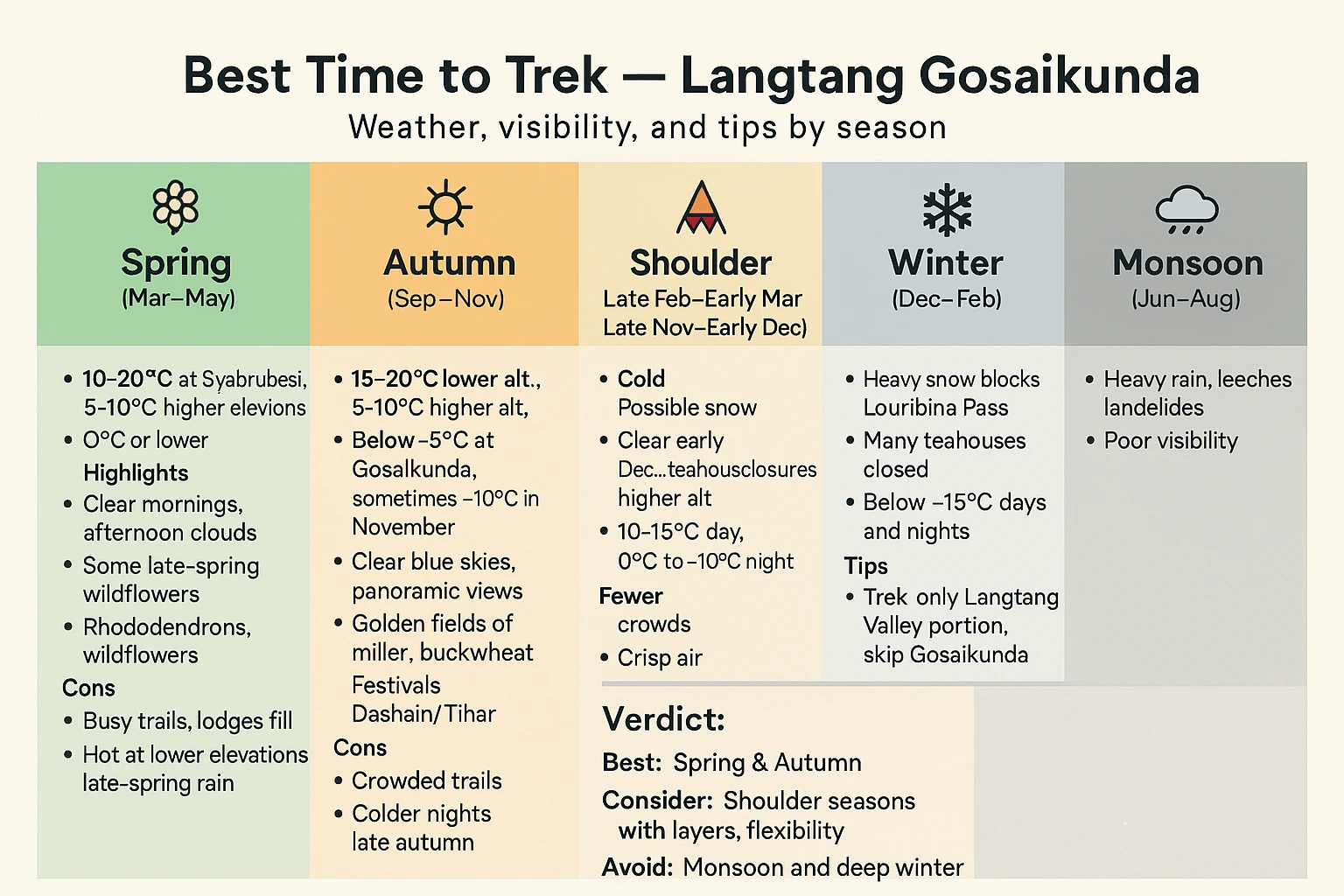
Spring (March to May): Known as one of the prime trekking seasons, Spring offers a balanced combination of clear views, blooming landscapes, and moderate weather. The temperature is mild at lower elevations, about 10-20°C in daytime at Syabrubesi. Higher elevations have daytime temperatures between 5-10°C and 0°C or lower at night. Mornings are clear with excellent mountain visibility, with some clouds building up by afternoon. There may be occasional rain showers or thunderstorms towards late spring. Spring is known for its blooming rhododendrons. The forests are full of red, pink, and white rhododendrons and wildflowers in the alpine meadows around Langtang.
Cons: However popular the season is, it brings many trekkers, trails might be busy, and lodges may fill out quickly. Lower altitudes can be hot, and late spring may bring rain.
Autumn (September to November): Autumn is the most popular trekking season. It is known for its crystal-clear skies, stable weather, and vibrant festivals. Since autumn is a post-monsoon season, the rain clears the dust and makes the valley lush green. Daytime temperature ranges between 15-20°C at lower altitudes and 5-10°C at higher elevations, with slightly colder conditions by November. Nighttime temperatures can go below -5 °C at Gosaikunda. The sky is consistently blue, and the visibility is excellent. You’ll likely get panoramic views of the mountains and the valleys almost daily. The village fields are golden with ripening crops like millet and buckwheat, with Gosaikunda water reflecting deep blue. Autumn also coincides with Nepal’s biggest festivals, Dashain and Tihar. If your trek overlaps with these festivals, you’ll get to see the local celebration.
Cons: Since the season is popular, trails can get extremely crowded. Nights are increasingly cold by late autumn.
Shoulder Seasons- Late February to Early March and Late November to Early December: Shoulder Seasons are ideal for fewer crowds with decent weather conditions. Late February to Early March is the ending period of winter. Days get longer and the snow starts melting, but there might still be snow around Lauribina Pass. Rhododendrons begin blooming at lower altitudes, and trails are quieter till mid-March. Bring layers for chilly nights.
Late November to Early December is the time after autumn. The temperature starts dropping when the skies are clear. Nighttime temperature can reach -10°C or lower with possible snow in Lauribina Pass by mid-December. However, early December is still manageable for a few trekkers. These shoulder seasons are great options for solitude and crisp air, but you need good prep for colder conditions and possible trail changes.
Winter (December to February): The Langtang Gosaikunda Trek’s Langtang Valley trek is possible during winter for the adventurous souls, but the Gosaikunda section is challenging and risky. Heavy snowfall blocks Lauribina Pass, and many teahouses around Gosaikunda are closed for the season. The freezing temperature with limited daylight makes the already challenging trek even harder. If you must, trek only in the Langtang Valley region and skip the Gosaikunda section for your safety.
Monsoon (June to August): We don’t recommend trekking during the monsoon season for safety reasons due to heavy rain. Trails are slippery with frequent landslides, leeches, and poor visibility. Clouds hide the mountains, and trekking in the Gosaikunda region is dangerous. On a more positive note, the landscape is green and lush with few trekkers, making it peaceful. But frequent rain, trail hazards, and almost no visibility make trekking difficult this season. If you can only trek during the monsoon, choose Nepal’s rain shadow zones like Upper Mustang and the Dolpo region, which receive little to no rain.
Thus, spring and summer are the best seasons for a Langtang Gosaikunda Trek. Opt for the shoulder seasons if you want fewer crowds but similar weather conditions. We don’t recommend winter and monsoon at all.
You have the option to extend your trek with some add-ons. These add-ons are entirely optional and come with extra charm. We respect your choice whether you want these add-ons or not. Let us know if you wish for any extensions while booking so we can arrange them for you in advance. You can also let us know while trekking, but availability might be a concern.
Kathmandu Valley Sightseeing: Go on a guided tour to some of Kathmandu’s UNESCO World Heritage Sites. You’ll visit the Swayambhunath Stupa (The Monkey Temple), Pashupatinath Temple, Bouddhanath Stupa, and different Durbar Squares of the valley. You will see the city in a private vehicle with a local guide to make the experience more comfortable and enriching.
Scenic Mountain Everest Mountain Flight: You can take an hour-long flight to see the aerial view of the Everest and the surrounding peaks. You will board an early morning flight for the best visibility. Each passenger will get a window seat, and the airline crew will point out major peaks for you. It is a great way to see the giant peaks without trekking.
Everest Base Camp Helicopter Tour: You can take a half-day helicopter tour to the Everest region. The flight will land on Kala Patthar (5,545m) for a close-up view of Everest, rather than at the Hotel Everest View for breakfast. The round trip takes about 4 to 5 hours and offers some of the best Everest views without trekking.
How to book: Visit our official website for details on the trek. Book and enter your group size with your preferred trekking date for the Langtang Gosaikunda Trek. If you can’t find a suitable date for a private trek, you can contact us for a custom trek.
Select your group size with personal information like name, passport number, dob, nationality, and contact information. You must pay a 20% deposit or the full amount upfront to secure your booking. We accept credit/debit cards, bank transfers, and our payment platform. We use the deposit to arrange permits, guides, and accommodation.
After payment, we will send an email with a confirmation, booking receipt, itinerary details, and other documents after we receive your payment. You can also book personal assistance directly with us over the phone.
Payment: We require a 20% non-refundable deposit to secure the booking. Although nonrefundable, you can transfer it to a different date with advance notice. The remaining 80% is due a few days before the trek. You can pay online or in Kathmandu after arrival. Our package lists all tour services with the prices in USD.
Cancellation Policy: Plans can change, and we try to be fair with our cancellation policy. We recommend travel insurance that covers trip cancellation for your financial protection. If you cancel more than 30 days before the departure, you get a full refund on all payments except the non-refundable deposit. Cancelling between 15-30 days means a 50% refund, and between 7-14 days means a 30% refund. If you decide to cancel 76 days before the trek or fail to show up, we don’t provide any refund. While the deposit is refundable, you can transfer it for a different date or use it as a credit, valid for up to one year for future use.
If we cancel the trek due to unforeseen circumstances, we will refund the entire payment or offer an alternative trek.
Yes, we provide complimentary transfers to and from the airport in Kathmandu as part of our package service. One of our team members will meet you at the airport, drive you to your hotel, and vice versa when you leave the country.
Yes, we will hold a pre-trek briefing the evening before you depart your hotel. Your guide will share the day-to-day itinerary and route, check your gear, and answer any last-minute questions. You can also go for last-minute gear shopping if you are missing anything.
You get a local’s insight into the region with a local company. We at Peregrine Treks and Tours employ local guides and porters, giving employment opportunities to different people. We handle all logistics directly with a license under Nepal’s Tourism Board, provide personalized support, and follow ethical working practices with flexible itineraries.
You need a Langtang National Park Permit and a Trekkers’ Information Management System (TIMS) card for the Langtang Gosaikunda Trek. We handle all permits for you as part of the package service. Send us a copy of your passport and a few passport pictures while booking.
You don’t need any prior trekking experience for the Langtang Gosaikunda Trek. However, you need decent fitness and be ready for 5-7 hours of daily hiking over trails you are not used to. Our itinerary includes acclimatization days and gradual altitude gain/loss to help the body adjust to the altitude.
You can safely keep your extra luggage at your hotel in Kathmandu. If you don’t find it safe or want an alternative, we can store your stuff at our office. You can pick it up after your trek.
Yes, most teahouses have electricity, and you can charge your devices here for a small fee. However, most teahouses generate electricity in the evening through solar or generator power. Charging may not be reliable in higher latitudes, so carry a power bank.
Most trails and villages have cell phone coverage with lower reliability as the altitude increases. Some lodges may provide WiFi for a small fee, but the signal may be weak or inconsistent in higher altitudes. You can buy a local NTC or NCell SIM card in Kathmandu for connectivity and data packages.
Yes, hot showers are available with a small fee. Water is gas-heated in lower villages and solar-powered in higher altitudes. You usually get a bucket of warm water as a hot shower, so don’t expect anything fancy.
You can refill your water bottle in teahouses as you go for a small cost. Alternatively, water purification methods like tablets or a portable filter can be used for safer drinking water.
Our trekking groups range from 2 to 10 people. We also welcome solo trekkers or private groups. Nepal is generally a safe country for women, and so is our trek. We can arrange a women-exclusive trekking group if you want. We regularly organize treks for women and prioritize safety, professionalism, and respect.
Teahouses prepare fresh meals for trekkers. Menu options typically include Nepali staples like Dal Bhat Tarkari, Tibetan bread, pasta, fried rice, soup, eggs, and seasonal vegetables.
Our guides have first aid and altitude sickness response training. They will coordinate immediate helicopter evacuation in case of severe injury or illness. You’ll descend to a lower village or the nearest hospital in mild conditions.
Yes, we require every trekker to have travel insurance to trek with us. It is a safety precaution and helps you in emergencies from drowning in financial debt. Your trekking insurance must cover trekking up to 5000m, an emergency helicopter evacuation, and medical care in Nepal.
You can tip about $100-150 to your guide and $60-100 to your porter per person. It is an average tipping amount and motivates your crew to do even better in future treks. You can give them tips at the end of the trek with a short message to show appreciation.
Yes, you can extend your trek. We often arrange extensions like the Chitwan Jungle Safari, Pokhara tours, paragliding, mountain flights, or a cultural tour around Kathmandu. Let us know before or after the trek so we can arrange them for you.
We hope this article clears your doubts about the Langtang Gosaikunda Trek. The Langtang Gosaikunda Trek offers Nepal’s natural and cultural beauty. It is ideal for those with decent fitness who want to get into higher-altitude trekking. Contact us today to begin your trekking adventure with us. Safe travels.