

Included Meals
- Breakfast: 17
- Lunch: 13
- Dinner: 14

Unbeatable Holiday Offers – Save Up to 20% on Your Next Adventure!
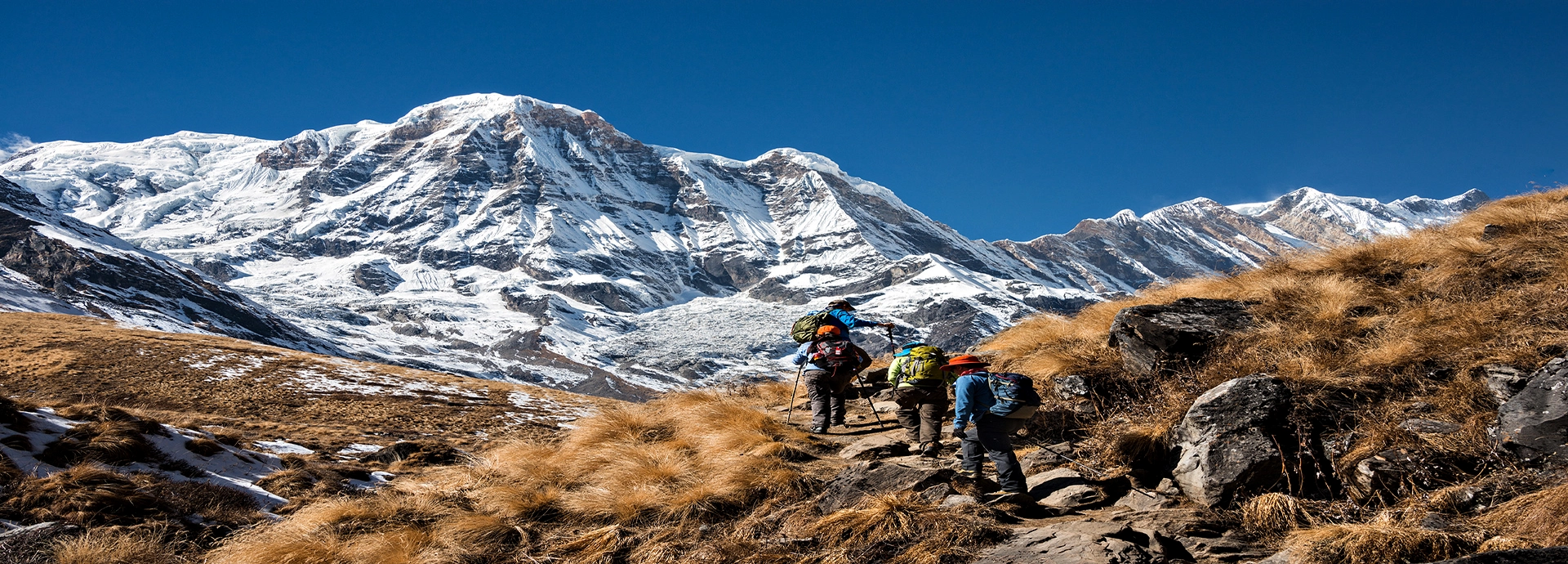
Tent Peak (5,663m/18,566ft), known locally as Tharpu Chuli, is one of the most approachable technical trekking peaks in Nepal’s Annapurna Sanctuary. Climbed on an 18-day trip that follows the classic Annapurna Base Camp trail before branching off to a two-camp glacier ascent, Tent Peak was first climbed in 1956 by Jimmy Roberts, widely credited as the founder of commercial trekking in Nepal. It is widely used as a first step into roped, crampon-and-ice-axe mountaineering, and as a preparation climb for the harder Singu Chuli (6,501m) and Hiunchuli (6,331m) nearby.
Note on peak height: most sources cite 5,663m, but at least one established operator lists 5,850m. Nepal Hiking Company uses 5,663m, the figure consistent with NMA documentation and the majority of independent sources. See the accuracy note below for full context.
Quick Facts
| Field | Value |
| Max Altitude | 5,663 m / 18,566 ft (see height accuracy note) |
| Duration | 18 Days |
| Grade | PD (Peu Difficile) — technical for its height |
| Region | Annapurna Sanctuary, Annapurna Conservation Area |
| Group Size | 2–15 recommended |
| Best Season | Spring (Mar–May) and Autumn (Sep–Nov) |
| Starts / Ends | Kathmandu |
| Accommodation | Teahouse/lodge to Annapurna Base Camp + tented camping above |
| Meals | Full board during trek/climb; B/B in Kathmandu and Pokhara |
| Transportation | Drive or flight Kathmandu–Pokhara; private jeep Pokhara–Nayapul |
| Activity Type | Trekking + Peak Climbing |
| Permits Required | Tent Peak / Tharpu Chuli Climbing Permit (NMA), ACAP, TIMS Card |
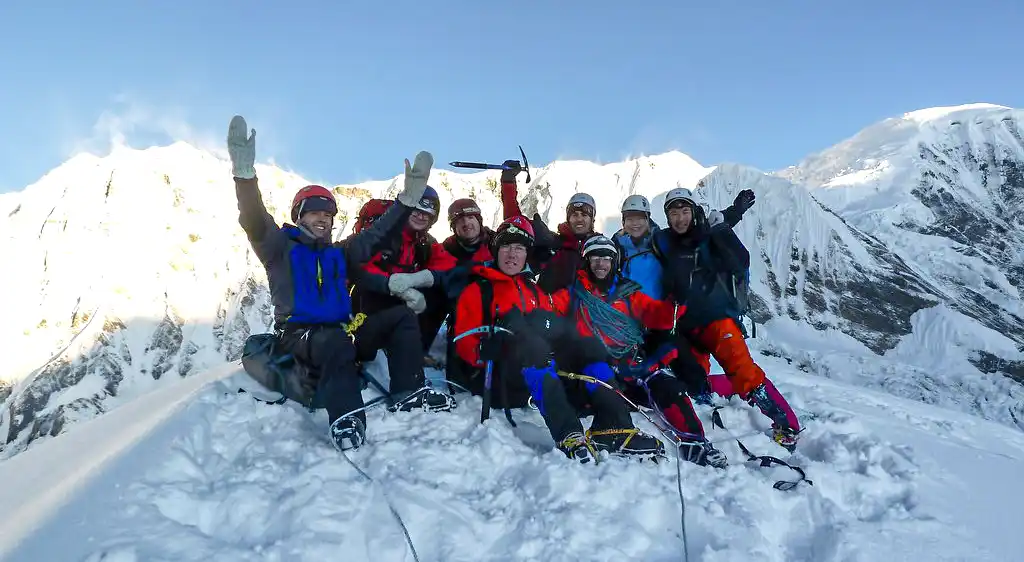
Tent Peak (5,663m), known by its Nepali name Tharpu Chuli, sits deep inside the Annapurna Sanctuary — the dramatic glacial basin ringed by Annapurna South and Hiunchuli to the south, Annapurna I to the west, Annapurna III and Gangapurna to the north, and Machhapuchhre (Fishtail) to the east. Its coordinates are approximately 28°35’05″N, 83°55’50″E.
The peak has a genuine historical footnote. Jimmy Roberts, a British army officer who later founded Mountain Travel Nepal in 1965 — widely credited as the world’s first commercial trekking agency — made the first ascent via the Southeast Ridge in 1956. That backstory gives Tent Peak a quiet significance beyond its modest altitude: it sits at the intersection of Himalayan mountaineering history and the birth of the trekking industry Nepal now depends on.
The Nepal Mountaineering Association classifies Tharpu Chuli as a trekking peak. Don’t read that as a synonym for “easy walk.” The standard Northwest Ridge route involves 35–40° snow slopes rising from High Camp (approximately 5,100m) and a narrow, exposed final ridge — roughly the last 60m to the summit — that genuinely requires fixed-rope protection and confident crampon technique. Several experienced guides describe the summit ridge of Tent Peak as harder, meter for meter, than the corresponding sections on taller but less steep trekking peaks.
The 18-day itinerary follows the classic Annapurna Base Camp trek — Ghorepani, Poon Hill, Tadapani, Chhomrong, and up through the Annapurna Sanctuary to ABC at 4,130m. From there, the route branches toward Tent Peak Base Camp and the two-camp climbing structure. Annapurna Base Camp is the last teahouse point. Tented camping takes over from ABC upward.
The route doubles as a natural acclimatization program. Unlike climbs where the approach trek is a brief formality, the Annapurna Sanctuary approach unfolds over many days of gradual altitude gain — from Nayapul at 822m through Ghorepani, Chhomrong, Dovan, Deurali, and Machhapuchhre Base Camp before reaching ABC at 4,130m. By the time you arrive at Tent Peak’s High Camp, your body has had nine solid days of acclimatization.
Tent Peak Climbing works well as a standalone first roped climb, a natural extension of an Annapurna Sanctuary trek, or a preparation objective for climbers aiming at the nearby Singu Chuli (6,501m) or Hiunchuli (6,331m). Companions who prefer trekking over climbing can join the Annapurna Base Camp section and return from ABC while the climbing group continues.

Included Meals

Trip staff
Guide
Potter

Transport
Public bus/jeep
flight

Accommodation
Hotel
Teahouse/lodge
Tented camp

Trip Grade
Group Size
A Nepal Hiking Company vehicle meets you at Tribhuvan International Airport. The NHC sign is visible at the arrivals gate. The drive to your hotel in Thamel takes 30–45 minutes, depending on Kathmandu traffic. Kathmandu sits at 1,400m, well below any altitude concern on arrival.
Spend the afternoon resting and getting acquainted with Thamel — Kathmandu’s trekking and climbing hub, stocked with gear rental shops in case anything from your packing list needs supplementing. In the evening, your guide visits the hotel for a short introductory meeting to confirm the next day’s schedule.
Accommodation:
3-star hotel in Thamel

Maximum Altitude 1,400m/4,593ft (Kathmandu )
Difficulty
A half-day heritage tour of Kathmandu’s UNESCO World Heritage Sites. Pashupatinath Temple — the sacred Shiva complex on the Bagmati River — comes first, followed by Boudhanath Stupa (36m, one of the world’s largest Buddhist stupas), and then Swayambhunath (Monkey Temple) on its hilltop above the valley.
The climb briefing begins. Your lead guide walks through the complete 18-day Tent Peak Climbing itinerary, the altitude profile, the technical sequence, and the emergency protocols. Personal gear goes out for inspection — every item from the packing list is checked. Missing or inadequate gear is now flagged. Thamel rental shops stock crampons, ice axes, harnesses, ascenders, and mountaineering boots.
All three permits — the Tent Peak / Tharpu Chuli Climbing Permit from the NMA, the Annapurna Conservation Area Permit (ACAP), and the TIMS Card — are confirmed today. NHC processes these in advance using your passport copy and photos submitted before arrival.
Accommodation:
Hotel
Meals Breakfast
Maximum Altitude 1,400m/4,593ft (Kathmandu )
Difficulty
Pokhara is the gateway city for the Annapurna region. The drive follows the Prithvi Highway west for approximately 200km — a scenic route through middle-hills terrain with the Trishuli River visible for much of the journey. The flight option takes 25 minutes and offers views of Manaslu, Himalchuli, and the Annapurna range from above.
Pokhara (915m) sits at the northern edge of Phewa Lake with Machhapuchhre (Fishtail, 6,993m) rising directly above the city. After the urban energy of Kathmandu, Pokhara feels noticeably calmer. The lakeside area offers excellent food and a good opportunity for a gear check double-take if anything was missed in Kathmandu.
Accommodation:
Hotel
Meals Breakfast
Maximum Altitude 822m/2,697ft (Pokhara )
Difficulty
Transportation Flight
A private jeep drives you from Pokhara to Nayapul (822m) — the standard trailhead for the Annapurna Circuit and Annapurna Base Camp approaches. The drive takes about 1.5 hours along a good road through the Modi Khola valley.
From Nayapul, the trail follows the Bhurungdi Khola river through lowland forest and terraced farmland. The first major settlement is Birethanti, where the ACAP and TIMS checkpoints stamp your permits. From Birethanti, the trail climbs steadily through Hile and up to Tikhedhunga (1,540m).
Tikhedhunga is a small settlement at the base of a long stone staircase that leads up to Ulleri — one of the more physically demanding stretches on the Annapurna approach. Rest well here. The stairs are your first encounter with the sustained climbing that characterizes the next few days.

Time & Distance 7Hour, 53KM
Accommodation:
Teahouse
Meals Breakfast, Lunch, Dinner
Maximum Altitude 1,540m/5,052ft (tTikhedhunga )
Difficulty
Transportation Jeep
The day begins with the famous Ulleri stone staircase — roughly 3,300 steps climbing from Tikhedhunga to Ulleri (1,960m). The climb is steep and continuous for about 90 minutes. Most trekkers pace themselves by focusing on breathing and taking short rest stops rather than fighting the gradient.
Above Ulleri, the trail levels somewhat into a rhododendron forest. In spring (March–April), the rhododendrons bloom in red and pink on both sides of the trail at these elevations — dense blooms that make the approach visually spectacular. The forest floor is carpeted with fallen petals.
Ghorepani (2,840m) is one of the most popular overnight stops on the Annapurna Circuit, thanks to its proximity to Poon Hill. The village has dozens of teahouses, hot showers, bakeries, and reliable Wi-Fi — a fully developed trekking hub despite its altitude. Book your Poon Hill sunrise alarm for 4:30 am.
Time & Distance 7Hour, 12KM
Accommodation:
Teahouse
Meals Breakfast, Lunch, Dinner
Maximum Altitude 2,880m/9,449ft (Ghorepani )
Difficulty
Wake up at 4:30 am. The hike from Ghorepani to Poon Hill takes 45 minutes on a well-maintained stone path. Most trekkers carry only a day pack and a warm jacket — temperatures at Poon Hill before sunrise drop to 3–5°C even in spring.
Poon Hill (3,210m) is one of Nepal’s most photographed sunrise viewpoints. What makes it work is geometry: the hilltop rises just high enough above the surrounding ridges to expose an unbroken 180-degree panorama. On a clear morning, you see Dhaulagiri (8,167m) to the west, the full Annapurna range — Annapurna South (7,219m), Annapurna I (8,091m), Annapurna III (7,555m) — directly ahead, Lamjung Himal (6,986m) to the northeast, and the perfect pyramid of Machhapuchhre (6,993m) to the north. The sky behind these peaks goes from black to purple to orange over about 30 minutes. The geometry of it — seeing eight 6,000m+ and 7,000m+ peaks simultaneously from a 3,210m viewpoint — is genuinely unusual in Nepal.
After returning to Ghorepani for breakfast, the day continues to Tadapani (2,610m) via Deurali (pass). The trail drops through rhododendron and oak forest. Tadapani is a quieter settlement than Ghorepani, with good views of Annapurna South and Machhapuchhre.
Time & Distance 7Hour, 14KM
Accommodation:
Teahouse
Meals Breakfast, Lunch, Dinner
Maximum Altitude 2,630m/8,629ft (Tadapani )
Difficulty
From Tadapani, the trail descends through bamboo and rhododendron forest before dropping steeply to the Modi Khola river. You cross the suspension bridge and then face an 800m staircase climb up to Chhomrong.
Chhomrong (2,140m) is the last Gurung village before the Annapurna Sanctuary entrance. The village spreads across a terraced hillside with stone-paved lanes between teahouses and shops. Annapurna South fills the western horizon from the upper terraces. Chhomrong is the most developed and social settlement on the upper approach — stock up on any food or supplies here. What’s available in Chhomrong is better quality and better priced than anything above it.
Time & Distance 5Hour, 11KM
Accommodation:
Teahouse
Meals Breakfast, Lunch, Dinner
Maximum Altitude 2,170m/7,119ft (Chhomrong )
Difficulty
The trail drops steeply from Chhomrong to the Modi Khola bridge at Sinuwa, then climbs through a mossy bamboo forest into the lower Sanctuary. The forest here is dense, cool, and damp — a sharp change from the open mountain views of the previous days.
Bamboo (2,310m) and Dovan (2,500m) are small settlements a few hours apart along this section. Both have teahouses, though the facilities are more basic than Chhomrong. The environment is exceptional — waterfalls, hanging moss, and the occasional Himalayan musk deer track visible in soft ground near the trail.
Overnight above the ACAP checkpoint, inside the Annapurna Sanctuary itself. The sanctuary entrance is a narrow gorge between Hiunchuli and Machhapuchhre — a natural geological bottleneck that creates the enclosed basin above.
Time & Distance 6Hour, 12KM
Accommodation:
Teahouse
Meals Breakfast, Lunch, Dinner
Maximum Altitude 2,600m/8,530ft (Dovan )
Difficulty
The trail continues up through the sanctuary, gaining significant elevation as the bamboo forest thins and alpine terrain opens above. Himalayan tahr (large wild goats with curved horns) are frequently visible on the rocky slopes above the trail here.
Deurali (3,230m) marks the transition to fully alpine terrain. The settlement sits on an open slope with few trees, directly beneath the glacier walls below Machhapuchhre. Snowfall is possible from Deurali upward at any time of year, even in late spring.
Keep altitude awareness active from Deurali upward. Drink three to four litres of water. Mild headache here is normal and usually temporary. If symptoms intensify — vomiting, loss of coordination, or difficulty breathing at rest — descend immediately and inform your guide.
Time & Distance 4Hour, 7KM
Accommodation:
Teahouose
Meals Breakfast, Lunch, Dinner
Maximum Altitude 3,230m/10,597ft (Deurali )
Difficulty
The trail from Deurali crosses a glacier moraine and passes Machhapuchhre Base Camp (MBC, 3,700m) — a cluster of teahouses beneath the southeast face of Fishtail. Machhapuchhre (6,993m) is Nepal’s most sacred unclimbed peak — climbing permits are not issued for it, so its summit remains untouched. The southwest face above MBC is a wall of ice and rock rising nearly 3,300m from base to summit.
From MBC, the trail continues northwest across the glacier basin to Annapurna Base Camp (ABC, 4,130m). The final approach is on an open moraine with the full 360° ring of sanctuary peaks visible from every angle. ABC has several teahouse facilities — this is the last teahouse accommodation on the route. From ABC upward, the itinerary switches entirely to tented camping.
Take time at ABC. Identify Tent Peak to the southeast — your guide points out the Northwest Ridge and the summit from base camp. Knowing the line you’ll climb in a few days changes how you view the summit from below.
Time & Distance 6Hour, 9KM
Accommodation:
Teahouse
Meals Breakfast, Lunch, Dinner
Maximum Altitude 4,130m/13,550ft (Annapurna Base Camp)
Difficulty
Annapurna Base Camp has historical significance beyond its altitude. Annapurna I (8,091m), visible directly above the camp, was the first 8,000m peak ever climbed — Maurice Herzog and Louis Lachenal summited it on June 3, 1950. Eighteen years earlier, the first serious reconnaissance of the Sanctuary took place here. Jimmy Roberts knew this basin well from his own expeditions. Standing at ABC, you are at one of the birthplaces of modern Himalayan mountaineering.
The morning follows the “climb high, sleep low” principle: a short hike up the moraine toward the Tent Peak approach, reaching approximately 4,400m, then returning to ABC for lunch. Total walking time is 2–3 hours. The afternoon is for gear rehearsal.
Your guide runs a crampon-fitting session, a harness check, and an introduction to the ascender (jumar) and descender techniques. Most clients have never used technical gear before this moment. One careful hour of practice removes the anxiety from the summit-day gear check at High Camp. Your guide also explains the Northwest Ridge route in detail — the snow slope angle, where the fixed ropes begin, and what the knife-edge final section looks and feels like before you arrive on it.
Accommodation:
Teahouse
Meals Breakfast, Lunch, Dinner
Maximum Altitude 4,130m/13,550ft (Annapurna Base Camp)
Difficulty
From ABC, the route heads southeast toward the approach to the Tent Peak glacier. The terrain changes from a teahouse-maintained trail to unmarked moraine and the glacial edge. Your guide leads. No signage marks this section.
Tent Peak Base Camp sits at approximately 4,500m on a relatively flat glacial moraine shelf with a clear view of the Northwest Ridge above. The camp team sets up tents, a cooking shelter, and a sanitation area before you arrive. Temperatures here drop to -5 °C to -10 °C overnight, even in spring.
After arriving at Base Camp, eat a full meal early and aim for a 7:30–8:00 pm lights-out. Your guide briefs the next day’s move to High Camp and confirms the summit-day weather forecast if satellite data is available. Organize your daypack for the next morning’s carry to High Camp.
Time & Distance 5Hour, 6KM
Accommodation:
Tented camp
Meals Breakfast, Lunch, Dinner
Maximum Altitude 4,500m/14,764ft (Tent Peak Base Camp)
Difficulty
Wake-up at 6:00am. You leave Base Camp with your full technical pack — harness, crampons, ice axe, ascender, and personal summit-day kit. Crampons go on as you transition from moraine to glacier ice, typically within 30–45 minutes of leaving camp.
The route gains elevation steadily on the lower glacier section. The 35–40° snow slope that defines the Northwest Ridge begins above the glacier flat. Your guide fixes ropes on the steeper sections for the group to move on. High Camp (approximately 5,100m) sits on a narrow ledge or compacted snow platform cut from the upper ridge.
After arriving and eating lunch, your guide runs the final technical review. The summit ridge — the last 60m of the climb — is explained in specific terms. More detail is in the Information Gain section below on what PD grade actually feels like on this specific summit. Rest is the priority after the briefing. Your guide sets a 2:00am or 3:00am wake-up for summit day.
Time & Distance 5Hour, 4KM
Accommodation:
Tented camp
Meals Breakfast, Lunch, Dinner
Maximum Altitude 5,100m/16,732ft (High camp )
Difficulty
Wake-up at 2:00am or 3:00am depending on conditions. A hot drink, energy bars, and brief porridge from the camp cook is the standard pre-summit breakfast. Full technical gear goes on in the tent with your headlamp. Your guide checks every harness buckle, crampon binding, and rope attachment before you leave camp.
The summit push begins in darkness. The first section climbs the fixed-rope snow slope from High Camp. At 35–40°, the slope demands active crampon technique — front-pointing on steeper sections, flat-footing on more moderate angles. The guide leads; the assistant guide brings up the rear.
The final 60m of the Northwest Ridge narrows considerably. What is a broad snow slope lower down becomes a genuine knife-edge — a few metres wide, with steep drops on both sides. Fixed ropes protect this section. You move one at a time through the exposed stretch, facing forward, crampons biting the ridge crest. Most clients describe this section as the most committed feeling of the entire trip.
The summit (5,663m) rewards the exposure with a close-range panorama inside the Sanctuary. Annapurna I (8,091m) rises above you to the west — the first 8,000m peak climbed, and from Tent Peak’s summit, a genuinely imposing wall of ice and rock. Annapurna South (7,219m), Hiunchuli (6,331m), Gangapurna (7,455m), and Machhapuchhre (6,993m) complete the encircling view. The basin floor of the Sanctuary is visible at a depth of 1,500m.
Descent follows the same fixed-rope line. Descending the knife-edge ridge is the moment that requires the most care — face into the slope, keep the crampon front points engaged, and use the brake hand consistently on the descender. Back at Base Camp by early to mid-afternoon. Full rest at Base Camp for the remainder of the day.
Time & Distance 9Hour, 10KM
Accommodation:
Tented camp
Meals Breakfast, Lunch, Dinner
Maximum Altitude 5,663m/18,579ft (Base camp)
Difficulty
The descent from Tent Peak Base Camp retraces the approach through the Annapurna Sanctuary. The gradient reverses in your favour, making progress faster — but the moraine and glacier sections still demand careful footwork on the descent, especially if conditions are icy from overnight freezing.
At Annapurna Base Camp, you pass back through the teahouses where you rested on Day 11. By MBC and Deurali, the air feels noticeably thicker. By the time you reach the bamboo forest below Dovan, the drop in altitude is physically tangible — deeper breaths, better appetite, more energy.
Dovan (2,500m) feels warm and relatively comfortable after five nights above 4,000m. Eat a full dinner, drink plenty of fluids, and rest well. Tomorrow brings the Jhinu Danda hot springs — a reward that the descent earns you.
Accommodation: Teahouse in Dovan. Meals: Breakfast, lunch, dinner included.
Time & Distance 6Hour, 12KM
Accommodation:
Teahouse
Meals Breakfast, Lunch, Dinner
Maximum Altitude 2,600m/8,530ft (Dovan )
Difficulty
The trail passes back through Chhomrong — the Gurung village that felt so lively on the way up feels even more welcoming on the descent. Stock up on snacks, cold drinks, and fresh food here.
From Chhomrong, the trail drops to the Modi Khola valley and follows a lower route toward Jhinu Danda (1,750m). Jhinu Danda is a small settlement famous along the Annapurna approach for one thing: natural hot springs fed by geothermal sources above the river. The springs are a 15-minute walk below the village — several tiled outdoor pools with water maintained at approximately 40°C. Soaking here after seventeen days of trekking and climbing has a reputation that precedes it.
Time & Distance 6Hour, 12KM
Accommodation:
Teahouse
Meals Breakfast, Lunch, Dinner
Maximum Altitude 1,780m/5,840ft (Jhinu Danda)
Difficulty
A final half-day trek from Jhinu Danda descends through terraced farmland and lower forest to Nayapul (822m) — the same trailhead where the trek began on Day 4. Total trekking time is 4–5 hours. A private jeep meets the group at Nayapul for the 1.5-hour drive back to Pokhara.
Arriving in Pokhara after 13+ days above 1,000m, the warm air and oxygen density at 915m feel remarkable. Spend the evening on Lakeside — Pokhara’s main restaurant and café strip along Phewa Lake — with Machhapuchhre reflected in the water ahead of you.
Time & Distance 8Hour, 53KM
Accommodation:
Hotel
Meals Breakfast
Maximum Altitude 822m/2,697ft (Nayapul )
Difficulty
Return to Kathmandu by tourist bus (6–7 hours, included) or domestic flight (25 minutes, approximately $100–140 extra). In the evening, Nepal Hiking Company hosts a farewell dinner at a Kathmandu restaurant. Your NMA summit certificate — printed with your name, the peak name (Tent Peak / Tharpu Chuli), the altitude (5,663m), and the ascent date — is presented at this dinner.
Tip envelopes for your guide and porters are traditionally distributed at the farewell dinner. Check-in for most international departures from Kathmandu requires 3 hours before flight time. Confirm your departure time with the hotel the evening before.
Time & Distance 7Hour, 200KM
Accommodation:
Hotel
Meals Breakfast, Dinner
Maximum Altitude 1,400m/4,593ft (Kathmandu )
Difficulty
Transportation Bus/ Flight
Nepal Hiking Company has run Himalayan expeditions from Kathmandu since 2008. We are registered with Nepal’s Department of Tourism, the Trekking Agencies’ Association of Nepal (TAAN), and the Nepal Mountaineering Association (NMA). An NMA-certified climbing guide leads every Tent Peak Climbing departure with active technical experience on the Annapurna Sanctuary peaks.
We address the peak-height discrepancy directly rather than quietly picking a number. Most published sources and NMA documentation support 5,663m. One established operator lists 5,850m. We use 5,663m, we explain why, and we confirm the figure with our guide team at the start of each season. You will not find us silently alternating between different altitudes on different pages.
Permit fees changed in September 2025. We confirm the current NMA rates via our membership access before each booking cycle. You see the confirmed figure in your quote — never a historic number copied from a competitor page.
Solo travelers are fully supported. Custom departure dates are available year-round. Fixed group departures run in prime spring and autumn windows. Companions who prefer the trek only — without the climbing phase — are accommodated within the same itinerary up to Annapurna Base Camp.
In 1956, British army officer Jimmy Roberts climbed Tent Peak’s Southeast Ridge during a Himalayan survey expedition. The climb pre-dates Nepal’s formal trekking-peak permit system by decades and was part of the broader post-war Himalayan exploration that followed the 1953 first ascent of Everest.
Roberts returned to Nepal and founded Mountain Travel Nepal in 1965 — the first commercially operated trekking agency in the world. Before Roberts, travel in the Nepali hills was an expedition affair requiring full logistical independence. Roberts packaged it: porters, guides, gear, food, and a fixed route. The commercial trekking industry that employs hundreds of thousands of people in Nepal today traces its origin to his 1965 agency.
Annapurna Base Camp, which you visit on this 18-day itinerary, is one of the routes that Roberts’s early trekking groups walked. Standing at ABC knowing that Roberts surveyed this same basin, and that Tent Peak was one of his objectives, gives the acclimatization day a bit more weight than a standard rest day.
The standard route on Tent Peak today follows the Northwest Ridge rather than Roberts’s original Southeast Ridge. Both routes reach the same summit. The Northwest Ridge is better suited to guided group climbing with fixed ropes and is now the standard permit-holding route for commercial expeditions.
From Kathmandu through Annapurna Base Camp (4,130m), you stay in teahouse guesthouses. Rooms are twin-sharing with basic beds and blankets. Shared bathrooms are standard above 2,500m. Hot showers are available at Ghorepani, Chhomrong, and most teahouses on the approach, typically solar-heated (reliable in spring, variable in autumn).
From Tent Peak Base Camp (approximately 4,500m) and High Camp (approximately 5,100m), accommodation is in four-season expedition tents provided by Nepal Hiking Company. Insulated sleeping mats and -20°C rated sleeping bags are also provided. You carry nothing heavier than a daypack — the porter team moves equipment between camps.
Sanitation at Base Camp and High Camp follows Leave No Trace principles. A toilet tent is set up downwind of sleeping tents. All waste is packed out per NMA garbage-deposit rules.
Trip Information
Teahouse menus on the Annapurna Base Camp trek are some of the best available on any trek in Nepal. The trail is long-established and well-supplied: dal bhat (lentil soup with rice, curry, and pickles), momo (steamed or fried dumplings), thukpa (noodle soup), pasta, pizza, pancakes, and fresh fruit are available from Tikhedhunga through ABC. Ghorepani and Chhomrong have full bakeries with cinnamon rolls, apple pie, and fresh bread.
At Base Camp and High Camp, the cook team prepares hot meals using EPI gas stoves. Food choices narrow above ABC — high-energy soups, porridge, pasta, and packaged options fill the camp menu. Hot drinks are always available at camp. Caloric intake at altitude naturally decreases; your guide actively encourages you to eat despite a reduced appetite.
Kathmandu to Pokhara by road takes 6–7 hours on the Prithvi Highway. A domestic flight cuts this to 25 minutes (approximately $100–140 each way). Both options are included depending on the choice made at booking. A private jeep covers the route from Pokhara to Nayapul (trailhead) in about 1.5 hours.
Permits Required
| Permit | Issued By | Season | Approx. Fee (2026) |
| Tent Peak / Tharpu Chuli Climbing Permit | Nepal Mountaineering Association | Spring | Confirm via NMA |
| Tent Peak / Tharpu Chuli Climbing Permit | Nepal Mountaineering Association | Autumn | Confirm via NMA |
| Garbage Deposit (refundable) | Nepal Mountaineering Association | All seasons | $500 |
| ACAP | NTNC | All seasons | NPR 3,000 (~$22) |
| TIMS Card | TAAN / NTB | All seasons | NPR 2,000 (~$15) |
⚠ Permit Fee and Peak Height Accuracy Notes
Peak height: most sources and NMA documentation cite 5,663m. At least one established operator lists 5,850m — a nearly 200m gap that is too large to be rounding. NHC uses 5,663m, confirmed with our guide team each season.
Permit fees: the NMA revised trekking peak permit fees, effective September 1, 2025. Confirmed current rates are provided in your booking quote. Do not rely on older published figures from competitor pages.
Camp elevations: Base Camp is listed between 4,400m and 4,700m, depending on the operator. High Camp appears between 5,000m and 5,200m. NHC uses our guide team’s current-season placements, which are confirmed before each departure.
Tent Peak Climbing rates PD (Peu Difficile, or “slightly difficult”) on the international alpine grading scale. That label is accurate but deserves context: PD on Tent Peak feels genuinely technical, particularly on the summit ridge.
The Northwest Ridge route involves 35–40° snow slopes rising from High Camp — demanding crampon technique but manageable for a well-coached beginner. The final 60m of the ridge narrows significantly. At its narrowest, the ridge crest is a few metres wide with steep drops on both sides. Fixed ropes protect this section. The exposure here is real, and most clients report it as the psychologically most intense part of the climb — distinct from the straightforward snow-slope climbing lower down.
Several experienced guides position Tent Peak’s summit ridge as harder, metre for metre, than comparable sections on taller trekking peaks like Mera Peak. Higher altitude doesn’t always mean more technical terrain. Tent Peak punches above its elevation in technical demand specifically because of that final knife-edge stretch.
Compared to Singu Chuli (6,501m, the natural next objective): Singu Chuli’s slopes are longer, steeper, and its fixed-rope sections are more extensive. The step from Tent Peak to Singu Chuli is real — Tent Peak is the appropriate first objective for climbers who haven’t used roped glacier gear before.
| Season | Months | Conditions | Notes |
| Spring ★★★★★ | March–May | Stable, warming | Best overall: firmer snow surface, longer days, clearer visibility. Rhododendrons bloom below 3,000m. |
| Autumn ★★★★☆ | September–November | Crisp, clear | Second-best: stable weather and excellent visibility. Busier trails due to festival season. |
| Winter ✗ | December–February | Severe cold | Not recommended: extreme cold at High Camp and risk of heavy snowfall blocking the Sanctuary entrance. |
| Monsoon ✗ | June–August | Rain, poor visibility | Not recommended: rain and leeches on lower trail, poor visibility in the Sanctuary, wet rock on summit ridge. |
The standard porter ratio is one porter per two clients. Each porter carries a maximum of 20kg. Nepal Hiking Company pays porters above the government minimum wage, provides cold-weather gear for all altitude sections, and covers porter medical costs if illness or injury occurs.
Personal climbing-gear rental is available in Thamel, Kathmandu. Budget $80–350 for a complete kit covering crampons, ice axe, harness, ascender, descender, and climbing helmet. Mountaineering boots are the most important individual item — test them with your crampons at the Day 2 gear check. Ill-fitting boots at High Camp at 5,100m cannot be exchanged.
A single-supplement applies for solo travelers wanting a private room where available along the route. Trekking companions who want to join the Annapurna Base Camp section only (without the climbing phase) are accommodated at the same per-day rate — contact NHC to arrange a combined itinerary.
Insurance Requirements
Standard trekking insurance does not cover Tent Peak Climbing. Your policy must explicitly cover mountaineering or technical climbing above 5,000m, helicopter evacuation, and rescue costs. Many standard “adventure sports” policies cap at 5,000m — confirm the altitude ceiling in your specific policy wording before purchasing.
Recommended insurers for Nepal trekking-peak climbing: World Nomads, BMC Insurance, Battleface, and Dogtag Adventure. Minimum recommended coverage: $30,000. Higher coverage ($50,000–$100,000 helicopter and rescue) provides a better margin.
Technical Gear (Personal — Rent or Bring)
Miscellaneous
The Annapurna Conservation Area is one of Nepal’s most visited natural environments and carries real pressure from trekking volume. Nepal Hiking Company applies specific practices rather than generic statements.
Porter welfare is the most visible issue on the Annapurna route. NHC pays porters above the government minimum, provides cold-weather gear above 3,000m, limits loads to 20kg, and gives porters paid sick time with medical support. Porters are never asked to travel unsafely.
The NMA garbage deposit ($500, refundable) creates accountability for waste at the climbing camps. NHC brings all camp waste — food packaging, human waste from sanitation tents, and non-organic materials — back down from Base Camp and High Camp. Clients carry their own personal waste from High Camp, sealed in bags provided at camp.
Buy from local teahouses and shops rather than relying entirely on supplies from Pokhara or Kathmandu. The teahouses at Chhomrong, Dovan, and ABC are family-run operations whose livelihoods depend on trekker spending. NHC staff are briefed on cultural sensitivity to Gurung and Thakali communities along the Annapurna approach.
Altitude sickness is the primary risk on the Annapurna Base Camp approach. Symptoms typically begin above 2,500m and can escalate rapidly above 4,000m. The multi-day acclimatization built into the approach trek — nine days from Nayapul to ABC — is the most robust natural acclimatization program of any trekking peak in Nepal. Still, monitor symptoms from Deurali upward and report any persistent headache or dizziness to your guide immediately.
The summit ridge is the specific technical hazard. The knife-edge final 60m carries real consequences for a fall, mitigated by fixed ropes and guide supervision. Crampon confidence and rope technique are tested here. The Day 13 training session at High Camp is designed precisely to prevent clients from arriving at the ridge without having practiced the movements.
The guide team carries a satellite phone and a first-aid kit at High Camp. Helicopter evacuation from inside the Annapurna Sanctuary is operationally possible and has been successfully executed. Your insurance must cover the cost, arranged on a pay-up-front basis, with reimbursement by your insurer afterward.
1. Underestimating the Summit Ridge Because the Altitude Looks Modest
Tent Peak’s summit at 5,663m looks more approachable than Pisang Peak (6,091m) or Chulu West (6,419m). Altitude alone doesn’t determine technical difficulty. The narrow final 60m of the Northwest Ridge — a genuine knife-edge with steep drops on both sides — is harder, meter for meter, than comparable ridge sections on several taller trekking peaks. Clients who arrive expecting a high-altitude snow walk are consistently surprised by the exposed character of the final stretch. Prepare for fixed-rope and exposed-ridge climbing, not just a steep snow slope. The PD grade is accurate precisely because of this section.
2. Treating the Annapurna Base Camp Trek as Just the Approach
Poon Hill, Chhomrong, the bamboo forest below the Sanctuary, Machhapuchhre Base Camp, and Annapurna Base Camp itself are not background noise for the climbing phase — they are one of Nepal’s great trek experiences in their own right. Rushing through them to reach the technical section is the most common pacing issue on this itinerary. The nine-day approach also serves as your acclimatization program. Cutting days from the approach doesn’t just reduce the scenery — it reduces the altitude adjustment time that makes the climbing camps safer. Respect the pace built into the schedule.
3. Not Budgeting for Personal Climbing Gear Rental
The package price covers group technical equipment — ropes, ice screws, pitons, and karabiners — and the camping setup at Base Camp and High Camp. It does not cover personal technical gear. Your ice axe, crampons, harness, ascender, descender, carabiners, climbing helmet, and mountaineering boots are excluded and must be rented or brought from home. Rental in Thamel runs approximately $80–350, depending on which items you need. Mountaineering boots are the most critical item. Do not attempt the summit ridge in trekking boots — the crampon compatibility is not there. Budget and plan for gear rental as a separate line item in your trip cost.
4. Skipping the Acclimatization Day at Annapurna Base Camp
Day 11 at ABC (4,130m) is an acclimatization day with a morning hike and an afternoon gear rehearsal. Some clients ask whether it can be cut to speed up the itinerary. The answer is no, not safely. From ABC, the itinerary moves to Base Camp (~4,500m) on Day 12 and High Camp (~5,100m) on Day 13. Arriving at High Camp without a properly paced acclimatization day at ABC dangerously compresses the altitude gain. The acclimatization day also serves a second function: the gear rehearsal on Day 11 ensures that crampon fitting, harness adjustment, and rope technique are checked before you’re at 5,100m in the dark, as you prepare for a summit push. Cutting Day 11 removes both benefits simultaneously.
5. Assuming Tent Peak and Singu Chuli are of similar difficulty
Both peaks sit in the Annapurna Sanctuary. Both are trekking peaks. Both involve fixed-rope climbing. The similarities end there. Singu Chuli (6,501m) is nearly 840m higher than Tent Peak and carries a PD+/AD grade — steeper slopes, longer fixed-rope sections, and a technically harder summit approach. Tent Peak is specifically designed as the first roped-climbing objective before Singu Chuli, not a parallel alternative. Clients who book Singu Chuli assuming Tent Peak is easy typically find Singu Chuli significantly harder than anticipated. If Tent Peak is your first time using crampons and a fixed rope, climb Tent Peak first and let your guide assess whether Singu Chuli is the right next step.
6. Booking Without Checking the Peak Height and Permit-Fee Figures
At least one established operator lists Tent Peak’s height as 5,850m — a nearly 200m discrepancy from the 5,663m figure used by most sources. Permit fees for trekking peaks changed in September 2025, and many competitor pages still show pre-revision rates. Both issues are real, and both affect how you plan and budget. Taking a single operator’s published numbers as ground truth without cross-referencing is how clients end up with inaccurate altitude expectations or budget shortfalls. Nepal Hiking Company confirms peak height and permit fees from current NMA sources at each booking cycle. Ask any operator you’re considering to provide the specific source for both figures.
| Peak | Max Alt. | Grade | Duration | Best For |
| Tent Peak (Tharpu Chuli) | 5,663m | PD — technical for its height | 18 days | First roped/crampon climb via the classic ABC trek |
| Singu Chuli (Fluted Peak) | 6,501m | PD+/AD — more technical | 20–22 days | Natural next step up from Tent Peak, same Sanctuary |
| Hiunchuli | 6,331m | Strenuous, technical | 20+ days | Advanced; for climbers already comfortable on Tent Peak |
| Pisang Peak | 6,091m | Moderate (PD) | 18 days | First 6,000m summit, Annapurna/Manang region |
| Mera Peak | 6,476m | Moderate | 15–18 days | Highest trekking peak, less technical, Khumbu region |
Jimmy Roberts made the first ascent of Tent Peak in 1956 via the Southeast Ridge during a Himalayan survey expedition. At the time, he was a British army officer stationed in Nepal and an experienced mountaineer who had participated in several significant Himalayan expeditions throughout the early 1950s.
Roberts’s lasting contribution to Nepal is not his ascent of Tent Peak but what came after it. In 1965, he founded Mountain Travel Nepal — widely recognized as the first commercially operated trekking agency in the world. Before Roberts, reaching the Himalayan interior required a full independent expedition: your own porters, your own food supply, your own route knowledge. Roberts packaged all of this for paying clients and created the commercial trekking industry. Nepal now hosts hundreds of thousands of trekkers annually. The industry employs hundreds of thousands of people and contributes billions to the economy.
Every competitor page that mentions Tent Peak references the 1956 first ascent and names Roberts. None develops the story further. The detail most worth knowing — that Roberts essentially invented commercial Himalayan trekking — is consistently skipped. Standing at Annapurna Base Camp on Day 11, on a trail that Roberts’s early clients walked, changes the experience slightly when you know the full history.
Tent Peak vs. Singu Chuli: Which Annapurna Sanctuary Peak Should You Climb?
Both peaks sit inside the Annapurna Sanctuary. Both require crampons, ice axes, fixed ropes, and NMA trekking-peak permits. Both approach from Annapurna Base Camp. Both offer extraordinary summit views.
The differences matter. Singu Chuli (6,501m, also called Fluted Peak) is 838m higher than Tent Peak and carries a PD+/AD grade versus Tent Peak’s PD. Singu Chuli’s slopes are steeper across a longer section. The fixed-rope climbing is more sustained. The summit itself is harder to access. For climbers who have never used technical gear before, Singu Chuli is not the right first objective.
The logical sequence is clear: Tent Peak first, Singu Chuli second. Tent Peak introduces glacier travel, crampon technique, ascender use, and the psychological experience of exposed fixed-rope climbing in a managed, guideable environment. The skills developed on Tent Peak transfer directly to Singu Chuli. Nepal Hiking Company can run both peaks on an extended itinerary of approximately 22–25 days for clients wanting to complete both in one visit.
If you are choosing between the two for a standalone first objective and have no prior technical climbing experience, choose Tent Peak. If you have previous technical climbing experience and are comfortable on fixed ropes, your guide can assess whether Singu Chuli is the right direct booking.
What PD Grade Actually Feels Like on Tent Peak’s Summit Ridge
“PD” — Peu Difficile, or “slightly difficult” in the international alpine grading system — is a broad category that covers a wide range of technical terrain. Understanding what PD actually means on Tent Peak requires separating the climb into two distinct sections.
The lower section, from High Camp to the base of the final ridge, involves 35–40° snow slopes. At this angle, a slope feels steep underfoot but doesn’t require front-pointing — flat-foot crampon technique works across most of this section. Fixed ropes provide security rather than being genuinely necessary for movement. This is the section most climbers manage more comfortably than they expected.
The final 60m of the Northwest Ridge is different. The broad snow slope narrows sharply. The ridge crest drops steeply on both sides. At its narrowest, you are moving along a feature that is a few meters wide with real exposure below. Fixed ropes are essential here — not just for security but because the angle and the narrow crest make unroped movement genuinely risky. You use your jumar on ascent and your descender on the return.
Most clients describe the summit ridge as the most committed experience of the entire Tent Peak climb. It isn’t the steepest section. It’s the exposure — the drop visible on both sides, the focused footwork required, the awareness that the rope is doing real work here, not just providing reassurance. That specific feeling is what makes Tent Peak a genuine first technical climbing experience rather than a steep snow walk. The PD grade is earned on those final 60 meters.
Why Tent Peak’s Height Is Reported Differently Across Operators
Tent Peak appears in operator listings at two meaningfully different elevations: 5,663m and 5,850m. A gap of nearly 200m is not a rounding difference. It needs an explanation.
The 5,663m figure appears in NMA documentation, the majority of independent cartographic sources, and most trekking-peak reference databases. The 5,850m figure appears on at least one well-known trekking operator’s website and has been repeated by other operators who sourced their figure from that page rather than from primary NMA or cartographic data.
Nepal Hiking Company uses 5,663m. Our guide team confirms this figure against the current NMA permit documentation at the start of each season. We do not average the two figures or present both as equally valid — the weight of independent evidence supports 5,663m, and presenting the discrepancy without a clear steer would simply pass the uncertainty on to you.
This matters practically in one context: insurance. Some policies set altitude coverage thresholds at 5,500m or 6,000m. If you are purchasing insurance based on an expected summit altitude of 5,850m, you may purchase different coverage than you need. Know which figure your operator uses, and confirm that your insurance covers the actual applicable altitude.
How the Annapurna Base Camp Trek Doubles as Your Acclimatization Program
On many trekking-peak itineraries, the approach trek is a few days of walking followed by a single designated acclimatization rest day before the climbing phase. Tent Peak’s approach is different — and better.
The Annapurna Base Camp trek takes nine full trekking days from Nayapul (822m) to ABC (4,130m). Elevation gain is spread across those days: Tikhedhunga (1,540m), Ghorepani (2,840m), Chhomrong (2,140m — a small descent), Dovan (2,500m), Deurali (3,230m), Machhapuchhre Base Camp (3,700m), and Annapurna Base Camp (4,130m). The gentle, multi-day profile gives your body extended time to adapt at each elevation band.
By the time you arrive at ABC and then at Tent Peak Base Camp (~4,500m), you have nine days of progressive altitude exposure behind you. The jump to High Camp (5,100m) on Day 13 is still a significant single-day gain, but your acclimatization base is far more robust than it would be after a single rest day at 3,500m.
This is why the standalone Annapurna Base Camp trek and the Tent Peak Climbing itinerary pair so naturally. You aren’t rushing to gain altitude for the climb — the trekking route does the acclimatization work for you, automatically, while delivering one of Nepal’s best approaches as the experience itself.
Nepal Hiking Company has operated Himalayan expeditions from Kathmandu since 2008. We are registered with Nepal’s Department of Tourism, TAAN, and the Nepal Mountaineering Association. Every Tent Peak Climbing departure is led by an NMA-certified guide with active technical experience on Annapurna Sanctuary peaks — not generalist trekking guides reassigned to climbing groups.
We use 5,663m for Tent Peak’s summit elevation, confirmed against NMA documentation each season. Permit fees are quoted from current NMA rates, not older competitor listings. Camp elevations are based on our guide team’s current season placements. You get accurate figures before you book.
Contact Nepal Hiking Company today for a customized quote based on your preferred dates, group size, and transport preferences. Fixed group departures run throughout spring and autumn. Private departures are available on your schedule year-round. The first response comes within 24 hours. The Annapurna Sanctuary is waiting.
From a technical-ridge angle: Tent Peak climbing rates PD (Peu Difficile) on the international alpine scale. The Northwest Ridge route involves 35–40° snow slopes from High Camp and a narrow, exposed final 60m that requires confident crampon technique and fixed-rope work. Several experienced guides describe the summit ridge as harder, meter for meter, than comparable sections on taller trekking peaks. The PD grade is accurate — but PD at 5,663m on a knife-edge ridge is a genuine technical experience, not a steep snow walk.
From an overall fitness angle, the 18-day itinerary involves nine days of sustained trekking before the climbing phase begins, with daily walking of 4–6 hours and continuous elevation gain from 822m to 4,130m. You need a strong aerobic base — 2–3 months of regular hiking with a loaded pack is the standard recommendation for preparation. Summit day runs 8–9 hours round-trip from High Camp. The entire trip is physically demanding, even without accounting for the technical section.
From a what’s-taught-on-site angle: Tent Peak is widely used as a first technical climbing experience precisely because the key skills — crampon technique, ascender and descender use, rope travel on a fixed line, and ice-axe positioning — can be taught effectively during the Day 13 High Camp training session and on the ascent itself. Your NMA-certified guide covers all of these techniques with individual attention. Most Tent Peak clients have never used technical gear before arriving at ABC.
From a what ‘s-required-beforehand angle, what you cannot learn on the mountain is cardiovascular fitness. A multi-day trekking experience at altitude — ideally a prior trek above 3,500m — is strongly recommended. You don’t need a mountaineering course, but you do need the physical endurance to sustain 8–9 hours of technical effort at altitude on summit day. If you have completed the standalone Annapurna Base Camp trek or a similar multi-day route, you have the experiential baseline that Tent Peak requires.
From a snow-condition and safety angle, spring (March–May) is the best overall season for Tent Peak Climbing. The snowpack on the Northwest Ridge is firmer and more stable in spring — better crampon purchase on the summit slope, lower avalanche risk on the Sanctuary approach, and longer daylight windows for summit day. May is the single most reliable month. Early March can carry residual winter conditions on the summit ridge, and late May brings pre-monsoon instability.
From a visibility and crowding angle, autumn (September–November) offers crisp, clear air and excellent visibility from Poon Hill and the summit. October is peak season on the Annapurna approach — teahouses fill quickly, particularly at Ghorepani and Chhomrong. Book teahouses in advance through your operator for autumn departures. The Annapurna Sanctuary itself is less crowded than the lower approach trail, regardless of season.
From a compliance angle, three permits are required. The Tent Peak / Tharpu Chuli Climbing Permit is issued by the NMA and is the primary technical permit — no licensed guide can lead a rope team to the summit without it. The Annapurna Conservation Area Permit (ACAP) covers all trekking within the conservation area boundary and is checked at the Birethanti checkpoint on Day 4. The TIMS Card registers your presence in the trekking zone. NHC processes all three permits before you arrive, using the copy of your passport and the photos you submitted in advance.
From a budget-planning perspective, the NMA revised trekking peak permit fees effective September 1, 2025. Many competitor websites still show pre-revision rates. NHC confirms current Tent Peak / Tharpu Chuli permit fees through our NMA membership access at every booking cycle — you see the confirmed figure in your personalized quote. ACAP costs NPR 3,000 (~$22), and TIMS costs NPR 2,000 (~$15). A $500 refundable garbage deposit also applies. Note also the peak-height discrepancy: NHC uses 5,663m, consistent with NMA documentation.
From a technical-difficulty angle: Singu Chuli (Fluted Peak, 6,501m) is 838m higher than Tent Peak and carries a PD+/AD grade versus Tent Peak’s PD. The slopes on Singu Chuli are steeper across a longer technical section. The fixed-rope climbing is more sustained, and the summit approach is harder to navigate in poor conditions. These are not minor differences — Singu Chuli is meaningfully harder than Tent Peak and should not be treated as an equivalent alternative for first-time technical climbers.
From a logical-progression angle, Tent Peak and Singu Chuli sit close together in the Annapurna Sanctuary and share a similar approach trail. Tent Peak is the standard first objective; Singu Chuli is the natural next step for climbers who have already completed Tent Peak. Nepal Hiking Company can design a combined itinerary of approximately 22–25 days for clients who want to attempt both peaks in a single trip. Contact us to discuss whether your climbing background is appropriate for a direct Singu Chuli booking.
From a technical-demand angle: Tent Peak’s summit ridge is harder per meter of climbing than either Mera Peak or Pisang Peak, even though Tent Peak has a lower absolute altitude than both. Mera Peak (6,476m) is primarily a long glacier approach with a non-technical final summit section. Pisang Peak (6,091m) has its own fixed-rope section but lacks the knife-edge ridge exposure that characterizes the summit of Tent Peak. Tent Peak sits in its own category: lower altitude, higher technical intensity per meter.
From a route and scenery angle: Tent Peak’s approach — the Annapurna Base Camp trek via Ghorepani and Poon Hill — is one of the most scenically complete treks in Nepal. Pisang Peak approaches via the Annapurna Circuit; Mera Peak via the Hinku Valley in the Khumbu. None of the three approaches is dull. Tent Peak’s advantage lies in the built-in acclimatization provided by the multi-day ABC trek and the experience of climbing within the enclosed Annapurna Sanctuary.
From a gear list perspective, the package includes all group climbing equipment — fixed ropes, ice screws, snow bars, pitons, and karabiners. Tents, sleeping mats, and -20°C sleeping bags are provided for all camping nights. The cook team and satellite phone are included. Personal technical gear — your own ice axe, crampons, harness, ascender (matched to your hand), figure-eight descender, carabiners, climbing helmet, and mountaineering boots — is excluded and must be rented or brought from home.
From a cost perspective, personal gear rental in Thamel, Kathmandu, costs approximately $80–350, depending on which items you need. Mountaineering boots are the most critical and most expensive item — book these early in the peak spring season, as popular sizes run out. Test every rental item — boots, crampons, harness — at the Day 2 gear check. Problems at High Camp at 5,100m cannot be easily corrected.
From a gradual ascent perspective, the Annapurna Base Camp trek offers the most naturally paced acclimatization of any peak-trekking itinerary in Nepal. Elevation gain is spread across nine days of varied terrain — Tikhedhunga, Ghorepani, Chhomrong, Dovan, Deurali, MBC, and ABC — with a built-in acclimatization day at ABC (4,130m) before the climbing camps. By the time you reach Tent Peak High Camp (5,100m), your body has had a week and a half of progressive altitude exposure. AMS symptoms above 2,500m are monitored by your guide from Day 5 onward.
From an emergency-response angle, the guide team carries a satellite phone and a first-aid kit. Helicopter evacuation from within the Annapurna Sanctuary is operationally feasible and has been successfully carried out. If any client develops signs of HACE or HAPE — confusion, loss of coordination, severe headache unresponsive to descent, or difficulty breathing at rest — the guide initiates immediate descent. Your insurance must cover helicopter evacuation costs, which are arranged on a pay-upfront basis and reimbursed by your insurer.
From a teahouse comfort angle: the Annapurna Base Camp approach has some of the best-developed teahouse infrastructure in Nepal. Ghorepani and Chhomrong in particular offer multiple-story lodges with private rooms, hot showers, Wi-Fi, and full bakeries. Above Dovan, facilities become more basic — shared bathrooms, simpler menus, and limited charging options. Annapurna Base Camp has several functional teahouses that serve as the last proper accommodation before the climbing camps.
From a high-camp tented-camping angle: Tent Peak Base Camp (~4,500m) and High Camp (~5,100m) use four-season expedition tents provided by NHC. -20°C sleeping bags are provided — a three-season bag is genuinely inadequate here. The camp cook prepares hot meals and drinks at each camp using EPI gas stoves. Food choices narrow above ABC, but warm food and hot drinks are always available. Force caloric intake at altitude, even when appetite is reduced — calorie deficiency at 5,000m dramatically increases fatigue.
From a realistic-readiness angle: yes, with the right preparation. Tent Peak is specifically positioned as the first roped-climbing objective in the Annapurna Sanctuary for a reason. The technical skills — crampon technique, ascender and descender use, rope travel — can be taught on-site during the High Camp training session. The approach provides excellent natural acclimatization. The guide-to-client ratio allows individual attention to the technical sections. Clients with solid trekking fitness and no prior technical climbing experience complete Tent Peak successfully at a high rate.
From a comparison-to-non-technical-treks angle: Tent Peak is meaningfully different from the standalone Annapurna Base Camp trek. The summit ridge requires technical gear, confidence in exposed terrain, and physical commitment over 8–9 hours. If you have not completed at least one multi-day trek above 3,500m, the standalone Annapurna Base Camp trek is the right first objective. Complete it, assess your fitness and altitude response, and then return for Tent Peak.
From a historical-first-ascent angle: Jimmy Roberts made the first ascent of Tent Peak (Tharpu Chuli) via the Southeast Ridge in 1956. He was then a British army officer stationed in Nepal and an experienced Himalayan mountaineer. The Southeast Ridge is no longer the standard commercial route — today’s guided expeditions use the Northwest Ridge, which is better suited to fixed-rope group climbing — but Roberts’s 1956 ascent established that the peak was accessible and defined its character as a technical but approachable Himalayan objective.
From a broader trekking-history angle: Roberts returned to Nepal after his military service and founded Mountain Travel Nepal in 1965 — the world’s first commercially operated trekking agency. He invented the formula that all Nepal-based trekking operators now follow: a fixed route, packaged logistics, employed local staff, and paying international clients. The Annapurna Base Camp trek that forms the approach to Tent Peak is a route that Roberts’s early clients walked in the late 1960s and 1970s. Visiting Annapurna Base Camp on Day 11 puts you in the physical space where commercial Himalayan trekking began.
From a pre-departure illness angle: Nepal Hiking Company’s standard policy allows a full deposit refund if cancellation is made 60 or more days before departure. Partial refunds apply between 30 and 60 days. Within 30 days of departure, the deposit is non-refundable because permit processing and porter engagement costs have already been incurred. Travel insurance covers deposit loss in most documented illness cases — this is one of the core reasons mountaineering travel insurance is required for booking, not optional.
From a weather-related trip-change angle: if poor conditions prevent a summit attempt within the standard itinerary and the buffer day is exhausted, NHC pursues a partial refund of the climbing permit cost from the NMA under its force majeure provisions. Weather-related changes to the descent route or any other logistical modification are handled as operational adjustments at no additional cost to the client.
From an NMA-issuance angle: yes. The Nepal Mountaineering Association issues a formal summit certificate for every climber who successfully reaches the summit of an NMA-registered trekking peak. Your Tent Peak certificate is printed on NMA letterhead with your full name, the peak name (Tent Peak / Tharpu Chuli), the summit elevation (5,663m), the ascent date, and the NMA registration number. Nepal Hiking Company processes certificate information before the trip and presents the completed document at the farewell dinner in Kathmandu on Day 18.
From a practical future-use angle, the NMA summit certificate serves as documentation of a completed technical ascent above 5,000m. For climbers planning to progress to Singu Chuli, Hiunchuli, or other higher peaks, the Tent Peak certificate demonstrates prior trekking-peak experience to future operators. Scan the document digitally before leaving Nepal and keep the original in a dry, protected envelope.
From a guide-and-satellite-phone response perspective, the guide team carries a satellite communication device and a comprehensive first-aid kit at High Camp. If a medical emergency occurs above the teahouse range — from Base Camp upward — the guide assesses the severity. It initiates either an assisted descent on foot or a helicopter evacuation request, depending on the urgency. Helicopter access to the Annapurna Sanctuary is technically possible and has been executed in previous emergencies. The guide coordinates the landing zone and manages communication with the rescue coordination system.
From an insurance-coverage angle: helicopter evacuation from inside the Annapurna Sanctuary involves complex flight dynamics and typically costs $3,000–$7,000 depending on conditions. Your insurance must explicitly cover helicopter evacuation from Nepal’s mountainous terrain. Standard trekking policies frequently cap at 5,000m — confirm your policy’s altitude ceiling covers 5,663m before purchasing. The helicopter operator requires a payment guarantee before dispatch. Your guide initiates the call; your insurance reimburses the cost after the fact.
From a natural itinerary overlap angle, Tent Peak Climbing already includes the full Annapurna Base Camp trek as its approach. You visit Ghorepani, Poon Hill, Tadapani, Chhomrong, and every standard ABC route stop on the way up — then retrace the descent via Jhinu Danda and its hot springs. If you want the standalone ABC trek experience and the Tent Peak summit, the 18-day climbing itinerary delivers both simultaneously. No separate ABC trek is needed.
From an added-value-for-non-climbing-companions angle, the itinerary naturally accommodates non-climbing companions who want the Annapurna Base Camp trek without the technical summit. Companions trek the full approach to ABC with the climbing group, spend Day 11 at ABC, and then return via the descent route while the climbing group continues to Tent Peak Base Camp. Nepal Hiking Company can arrange this split itinerary on request — contact us to discuss logistics and per-person pricing for the trekking-only component.