


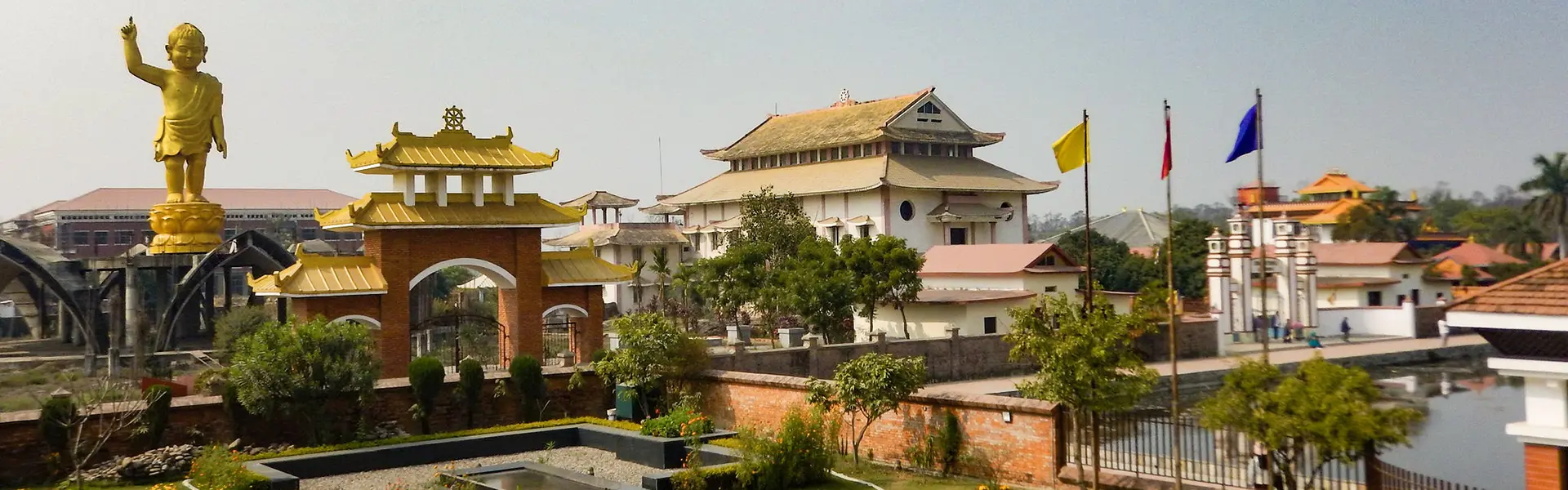

Lumbini stands as one of the most important places in the world for Buddhists and cultural travelers alike. Siddhartha Gautama, who later became the Buddha, was born here over 2,500 years ago. UNESCO confirms the birthplace through the inscription on the Ashoka pillar found at the site and recognizes the archaeological remains as evidence of very early Buddhist pilgrimage activity.
The best places to visit in Lumbini extend far beyond a single monument. The site spreads across a carefully planned landscape that includes an ancient sacred core, two large monastic zones with temples built by more than twenty countries, a central peace canal, a research institute, and nearby heritage sites that extend the circuit across Nepal’s Terai plains.
Use this guide to find the right places for your travel style, build a one-day or two-day plan, and understand what makes each part of Lumbini worth your time — whether you come as a pilgrim, a cultural traveler, an architecture enthusiast, or a first-time Nepal visitor looking for a quiet and meaningful stop.
Quick Answer: What Are the Best Places to Visit in Lumbini?
- Maya Devi Temple: The most sacred structure in all of Lumbini. Marks the exact birthplace.
- Marker Stone: The precise nativity point inside Maya Devi Temple.
- Ashoka Pillar: A 3rd-century BCE stone column that confirms the birthplace through inscription.
- Puskarini Pond: The sacred pond outside Maya Devi Temple. Strong for prayer and photography.
- Royal Thai Monastery: One of the most elegant Theravada monasteries in the East Monastic Zone.
- Chinese Monastery: A striking Mahayana temple complex in the West Monastic Zone.
- Central Canal and Eternal Peace Flame: The symbolic spine linking Sacred Garden to the monastic world.
- World Peace Pagoda: A Japanese-built stupa with open views across the Lumbini plains.
Why Lumbini Is More Than Just One Monument
Many visitors arrive expecting a single temple and leave surprised by how much Lumbini has to offer. The site covers several square kilometers of planned sacred landscape. A master plan developed by Japanese architect Kenzo Tange divides Lumbini into three zones: the Sacred Garden at the core, the East and West Monastic Zones, and the New Lumbini Village area with the cultural center.
Moving through Lumbini means moving through layers of Buddhist history, global religious architecture, and open peaceful space. Pilgrims come to pray at the birthplace. Architecture lovers study temples from Thailand, China, Japan, Korea, Myanmar, Sri Lanka, Vietnam, Germany, France, and dozens of other countries. Photographers find a landscape of still water, stupa silhouettes, and early morning light that rewards patience.
Private Nepal tour benefits stand out clearly at Lumbini. A knowledgeable guide explains the master plan layout, the significance of each zone, and the architectural traditions behind each monastery. Without that context, visitors often leave having seen impressive structures but understanding very little of what they represent.
Lumbini at a Glance
| Category | Details |
|---|---|
| Ideal Stay Length | 1 to 2 days (2 days covers both monastic zones fully) |
| Top Highlights | Maya Devi Temple, Ashoka Pillar, Puskarini Pond, East and West Monastic Zones |
| Best For | Pilgrims, cultural travelers, architects, photographers, quiet-seekers |
| Best Season | October to March (cool, dry, and comfortable for walking) |
| Best Transport | Bicycle or electric rickshaw (the site is too large to walk in full comfort) |
| One-Day Visit | Sacred Garden and one full monastic zone |
| Two-Day Visit | Sacred Garden, both monastic zones, museum, World Peace Pagoda |
| UNESCO Status | World Heritage Site since 1997 |
Best Places to Visit in Lumbini
The Sacred Garden
The Sacred Garden forms the epicenter of Lumbini. Every visit starts here. The zone holds the most important archaeological and spiritual sites in the entire complex. Allow at least 1.5 to 2 hours for a respectful, unhurried visit.
Maya Devi Temple
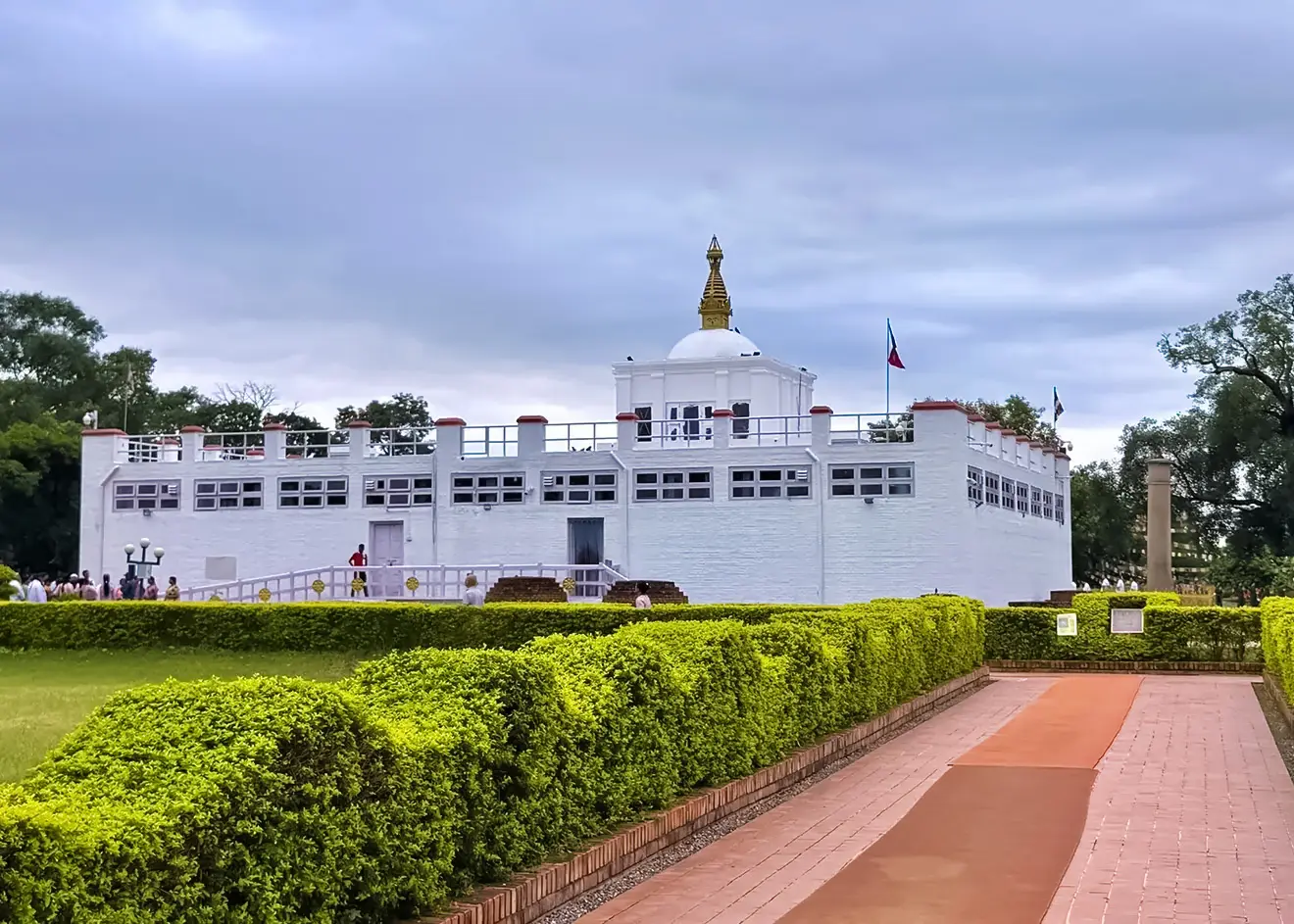
Maya Devi Temple marks the exact birthplace of Siddhartha Gautama. The current structure protects ancient brick foundations excavated from multiple layers of construction. A glass walkway lets visitors look across the archaeological foundations below. The oldest confirmed layers date to the 3rd century BCE. Inside the temple, the Marker Stone marks the precise spot of the birth. The nearby Nativity Sculpture depicts Maya Devi holding a sal tree branch as Siddhartha Gautama entered the world. Both objects hold profound significance for Buddhist pilgrims across all traditions.
- Why visit: The central sacred site and confirmed birthplace of the Buddha.
- Best for: Pilgrims, first-time visitors, history-minded travelers.
- Time needed: 45 minutes to 1 hour inside the temple. Longer for quiet reflection.
- Best time: Early morning before tour groups arrive.
- Visitor tip: Remove shoes before entry. Dress modestly. Leave food and drinks outside. Buy entry tickets before approaching the gate.
Ashoka Pillar
Emperor Ashoka erected the Ashoka Pillar in 249 BCE during his pilgrimage to Lumbini. The inscription carved into the stone confirms Lumbini as the birthplace of the Buddha. UNESCO cites this inscription as direct evidence of the site’s authenticity. The pillar stands a few meters from Maya Devi Temple behind a protective fence. Read the inscription translation at the nearby interpretation panel before examining the column. The pillar’s simple stone form carries more historical weight than most monuments ten times its size.
- Why visit: A 2,300-year-old stone monument with an inscription confirming the birthplace.
- Best for: History lovers, all visitors.
- Time needed: 20 to 30 minutes.
- Best time: Morning.
- Visitor tip: Read the translation of the inscription first. The words give the pillar its full meaning.
Marker Stone and Nativity Sculpture
The Marker Stone lies within the Maya Devi Temple and marks the exact nativity point. Lumbini Development Trust identifies it as the exact spot where Siddhartha Gautama was born. Pilgrims often stand here in complete silence for several minutes. The Nativity Sculpture depicts Maya Devi holding a sal tree branch at the moment of birth. Both objects deserve quiet attention rather than a hurried glance. Approach them with the same calm you would bring to any deeply sacred space.
- Best for: Pilgrims, cultural and spiritual travelers.
- Time needed: Included in the Maya Devi Temple visit.
- Visitor tip: Lower your voice completely inside the temple. Many visitors come here to pray.
Puskarini Pond and the Sacred Surroundings
Puskarini Pond, just outside Maya Devi Temple, holds strong symbolic meaning. Maya Devi bathed here before the birth of Siddhartha Gautama, according to Buddhist tradition. Pilgrims bathe in the waters or perform prayers along the stone steps at the pond edge. The pond reflects the Sacred Garden trees and temple structures on still mornings. Early morning visits produce strong photography conditions. Lotus plants, pilgrims in prayer, and the old trees surrounding the water create a scene that many visitors describe as the single most memorable moment of their Lumbini visit.
- Why visit: Sacred pond with deep symbolic meaning and exceptional photographic conditions.
- Best for: Pilgrims, photographers, reflective travelers.
- Time needed: 20 to 30 minutes.
- Best time: Sunrise or early morning for still water and soft light.
- Visitor tip: Spend genuine quiet time here rather than moving straight to the next site.
East Monastic Zone
The East Monastic Zone holds monasteries built in the Theravada tradition, practiced widely across Thailand, Myanmar, Sri Lanka, Cambodia, and Laos. The visual language here runs toward white and gold surfaces, layered rooflines, and formal, symmetric layouts. The overall atmosphere feels lighter and more open than the West Monastic Zone.
Royal Thai Monastery
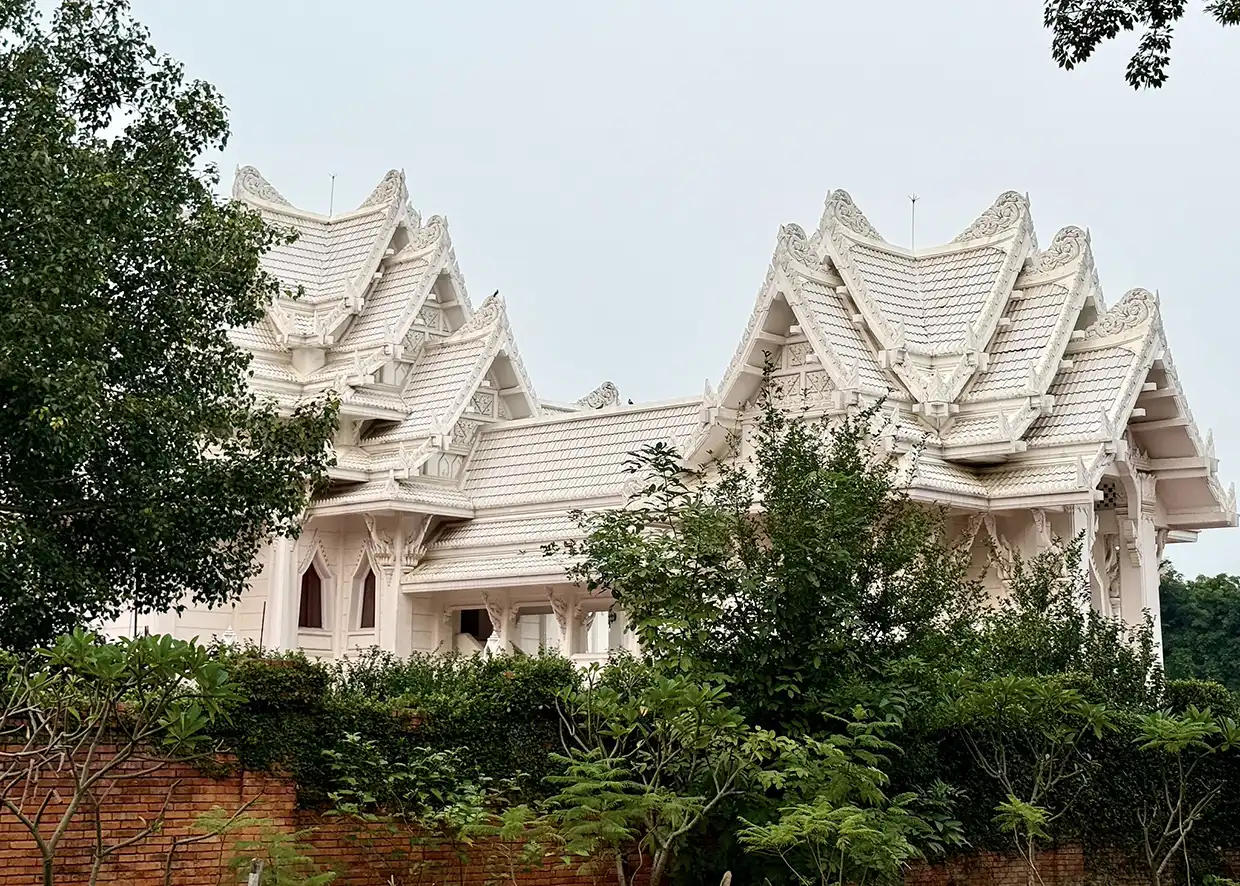
The Royal Thai Monastery ranks among the most architecturally refined structures in Lumbini. White spires, gold details, intricate woodwork, and a classical Thai layout create a structure that rewards slow exploration from every angle. Gardens, walking meditation paths, and an ornate main prayer hall fill the compound. Visit in the morning when gold details catch the early light and the compound stays calm. The Royal Thai Monastery gives first-time visitors a strong first impression of what the East Monastic Zone offers.
- Why visit: One of the most elegant monastery structures in Lumbini.
- Best for: Architecture lovers, photographers, and all visitors.
- Time needed: 30 to 45 minutes.
- Visitor tip: Remove shoes before entering any prayer hall inside the compound.
Myanmar Golden Temple
The Myanmar Golden Temple brings a distinctive Burmese architectural style to the East Monastic Zone. A gilded central stupa reflects Myanmar’s most deeply rooted Buddhist traditions. Smaller stupas, a main prayer hall, and carefully maintained gardens fill the compound. Myanmar-style architecture features a layered spire that differs noticeably from the nearby Thai and Chinese structures. Visiting both the Thai and Myanmar monasteries in the same morning gives a strong sense of how different national traditions express shared Buddhist values through distinct visual forms.
- Best for: Architecture lovers, comparative religious travelers, and photographers.
- Time needed: 20 to 30 minutes.
Sri Lankan Monastery and International Gautami Nuns Temple
The Sri Lankan Monastery brings a clean, restrained Theravada design from South Asia’s oldest continuous Buddhist culture. The compound suits visitors who prefer a quieter, more meditative atmosphere than the larger Thai and Myanmar structures. The International Gautami Nuns Temple nearby holds special significance for Buddhist women practitioners and scholars. The temple welcomes all respectful visitors regardless of tradition.
- Best for: Pilgrims, female travelers, quiet-seekers.
- Time needed: 20 minutes.
West Monastic Zone
The West Monastic Zone holds monasteries from the Mahayana and Vajrayana traditions, practiced across China, Japan, Korea, Tibet, and Vietnam. The visual language shifts dramatically here toward blue and green roof tiles, painted murals, dragon motifs, and layered decorative detail. Visiting both monastic zones gives a fuller picture of Lumbini’s role as a meeting point for all Buddhist traditions.
Chinese Monastery
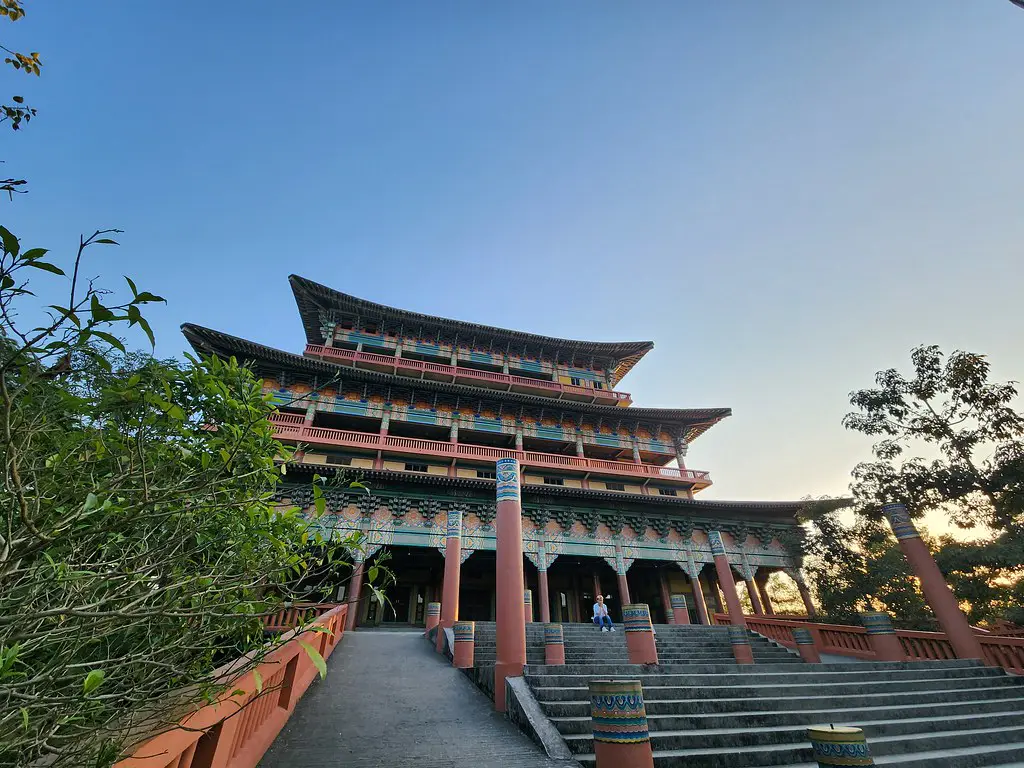
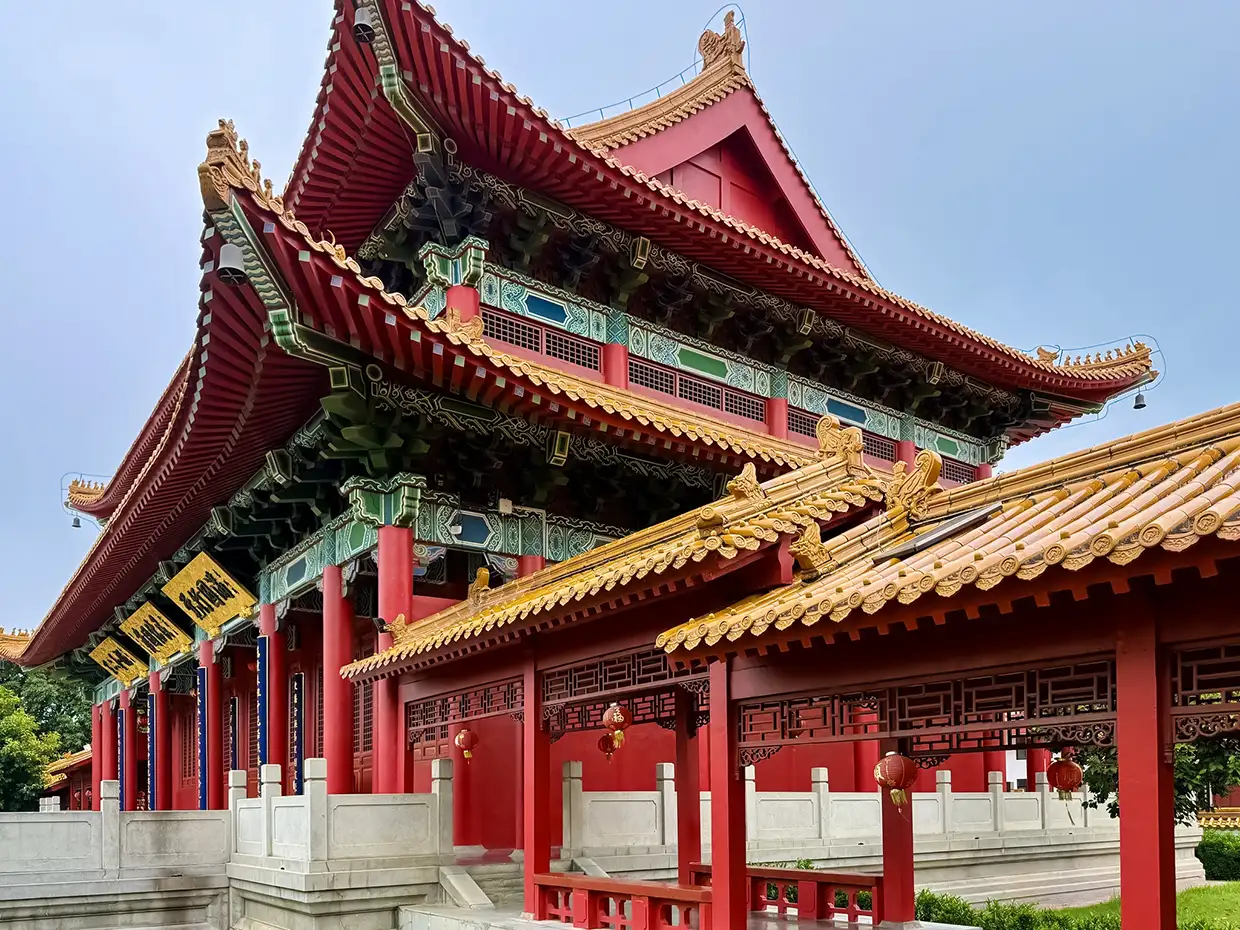
The Chinese Monastery stands as one of the most visually striking structures in the West Monastic Zone. Sweeping rooflines, red-lacquered pillars, courtyard gardens, and an ornate main hall create a dramatic contrast with the golden Thai structures across the canal on the east side. Inside the main hall, large painted murals and gilded statues fill the space with color. Walk through the full compound rather than stopping at the entrance gate. The rear courtyard gives the best angles for photography and architectural appreciation.
- Why visit: Strong visual contrast to the East Zone. An excellent example of Chinese Buddhist temple design.
- Best for: Architecture lovers, photographers, culture travelers.
- Time needed: 30 to 45 minutes.
- Visitor tip: Walk to the rear courtyard for the best photography and building detail.
Korean Monastery
The Korean Monastery brings a distinct Korean Buddhist temple style to Lumbini. Stone lanterns, tiered wooden halls, and a quieter atmosphere define the compound. Korean Buddhist architecture sits between Chinese formality and Japanese restraint in its visual approach.
- Best for: Architecture enthusiasts, quiet reflection.
- Time needed: 20 to 30 minutes.
Great Lotus Stupa and Vajrayana Presence
The Great Lotus Stupa, associated with the Tara Foundation, presents a Vajrayana visual vocabulary unfamiliar to many visitors. The lotus form references one of Buddhism’s most important symbols of purity and spiritual awakening. White and gilded surfaces catch the light across the flat surrounding ground.
Multiple Tibetan- and Vajrayana-influenced structures across the West Monastic Zone add depth for travelers familiar with Himalayan Buddhist traditions.
- Best for: Photographers, spiritual travelers with a Tibetan Buddhist background.
- Time needed: 20 minutes.
The Central Canal, Eternal Peace Flame, and Peace Bell
The central canal runs as the symbolic spine of the entire Lumbini master plan. Starting near the Sacred Garden and extending through both monastic zones toward the New Lumbini Village, the canal creates the processional axis that connects every part of the site.
Walking or cycling along the canal gives a strong sense of Lumbini’s full scale. Boat rides on certain canal sections offer a quieter way to move between zones. The Eternal Peace Flame burns continuously near the canal intersection point and expresses the aspiration for global peace that defines Lumbini’s modern identity.
The Peace Bell hangs near the canal axis and invites visitors to ring it as a personal act of goodwill. Both the Peace Flame and Peace Bell attract visitors of all backgrounds. Premium vs budget Nepal tour options both include a canal segment, but private arrangements let you spend more time at specific peace landmarks without group schedules.
- Why visit: The symbolic backbone of Lumbini. Links all zones and carries the site’s peace identity.
- Best for: All visitor types.
- Time needed: 30 minutes to 1 hour for a canal walk or short boat ride.
- Visitor tip: Cycle or take an electric rickshaw along the full canal length. Walking the entire route takes longer than most visitors’ budgets allow.
Museums and Interpretation Stops
The Lumbini Museum holds archaeological finds from the site and the surrounding Terai region. Sculptures, coins, ceramics, and excavation records give strong historical context to the Sacred Garden visit. History-minded travelers find the museum adds a layer that outdoor panels alone cannot provide.
The Lumbini International Research Institute, located near the museum, publishes ongoing research on the site’s archaeology, Buddhist studies, and conservation. Researchers and serious students of Buddhism find the library and publications worthwhile. Verify current visitor access before your trip, as the museum is undergoing phased restoration with variable opening hours.
- Best for: History lovers, researchers, context-minded travelers.
- Time needed: 45 minutes to 1 hour.
- Visitor tip: Check opening hours before planning your museum stop.
Greater Lumbini Add-Ons
Several strong attractions extend the Lumbini experience beyond the main master plan zone. Some work as easy half-day additions. Others suit travelers on a deeper Buddhist heritage circuit.
World Peace Pagoda
Japanese Buddhist organization Nipponzan Myohoji built the World Peace Pagoda near the New Lumbini Village. A large white stupa with Buddha images on each cardinal side, the pagoda offers open views across the surrounding flat Terai. The quiet garden setting and clean architecture make it a strong add-on for any Lumbini visit.
- Why visit: One of Asia’s most carefully designed peace stupas, with wide-open surroundings.
- Time needed: 30 to 45 minutes.
- Best time: Late afternoon for soft light on the white stupa.
Lumbini Crane Sanctuary
Lumbini and the surrounding Terai fields hold over 250 recorded bird species, including the Sarus Crane — one of the world’s tallest flying birds. The Lumbini Crane Sanctuary protects wetland habitat within the greater Lumbini development zone. Birdwatchers find the sanctuary a genuine draw, completely separate from the archaeological and monastic highlights. Early morning visits between October and March give the best chances of crane sightings.
- Best for: Birdwatchers, nature travelers.
- Best time: Early morning, October to March.
- Time needed: 1 to 2 hours.
Tilaurakot and Buddhist Circuit Extensions
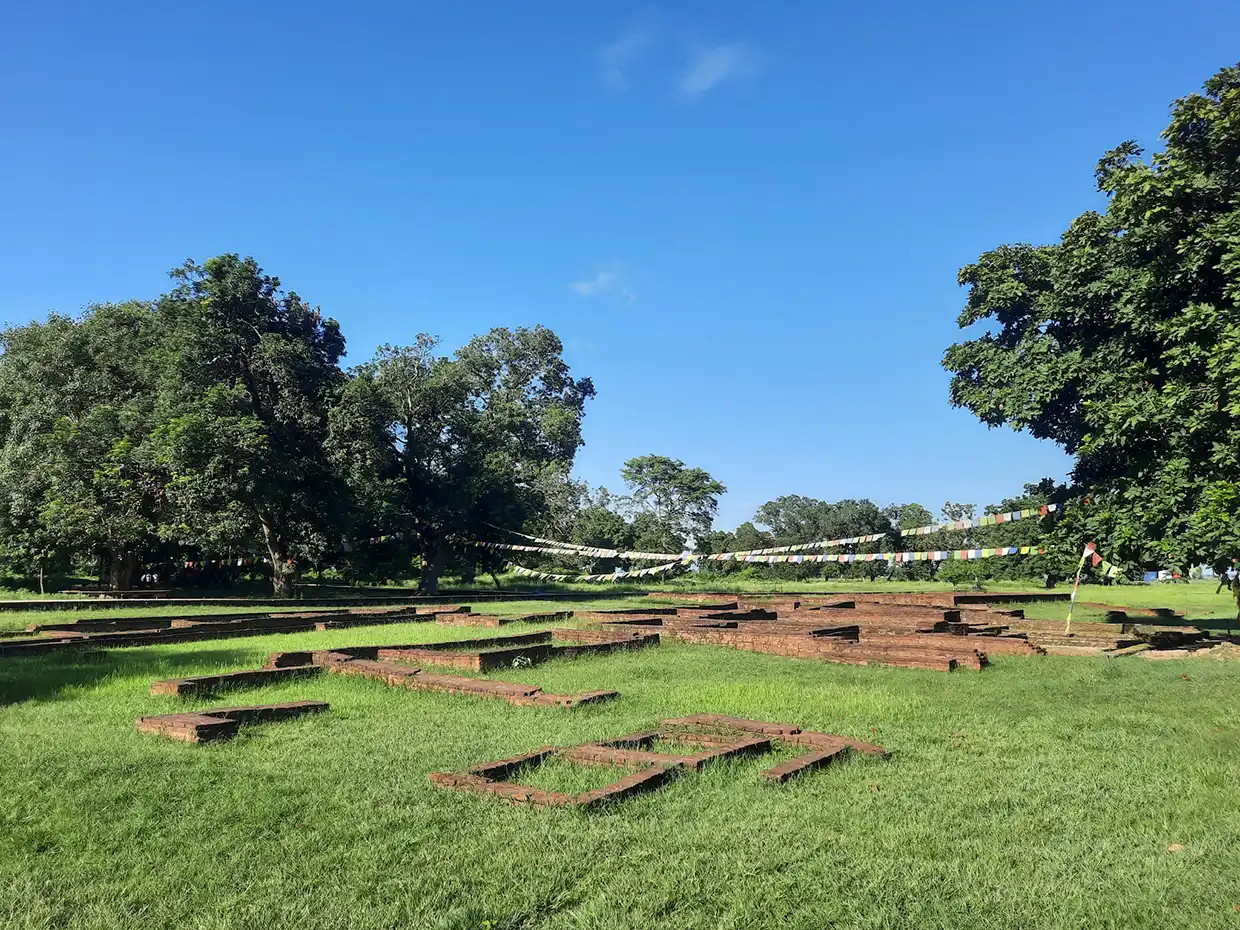
Tilaurakot, identified as the ancient Kapilavastu where Siddhartha Gautama grew up, sits roughly 27 kilometers from Lumbini. Archaeological excavations have revealed palace foundations, city gates, and remnants of the ancient city’s moat.
Ramagrama, which holds the only intact original stupa from the time of the Buddha’s relics, lies a further drive east. These sites suit travelers on the broader Buddhist heritage circuit rather than one-day visitors. Private Nepal tour benefits apply strongly here: a private vehicle and guide make the Tilaurakot and Ramagrama circuit efficient and historically rich in a single long day from Lumbini.
- Best for: Serious pilgrims, Buddhist heritage circuit travelers.
- Time needed: Full-day excursion from Lumbini base.
Best Places to Visit in Lumbini by Travel Style
Best Places for First-Time Visitors
- Must-see: Maya Devi Temple, Marker Stone, Ashoka Pillar, and Puskarini Pond.
- Add: Royal Thai Monastery in the East Monastic Zone.
- Add: Chinese Monastery in the West Monastic Zone.
- Add: Canal walk and Eternal Peace Flame.
- Add: World Peace Pagoda for a wider view of the Lumbini landscape.
- Deeper add-on: Lumbini Museum for historical context.
Best Places for Pilgrims
- Must-see: Maya Devi Temple, Marker Stone, Nativity Sculpture, and Puskarini Pond.
- Add: Bodhi Tree devotional area in the Sacred Garden.
- Add: Monasteries from your own Buddhist tradition in the relevant monastic zone.
- Add: Peace Bell at the canal as a personal act of dedication.
- Deeper add-on: Tilaurakot for a connection to Siddhartha’s childhood and early life.
Best Places for Architecture Lovers
- Must-see: Royal Thai Monastery and Chinese Monastery for the clearest architectural contrast.
- Add: Myanmar Golden Temple and Korean Monastery.
- Add: Great Lotus Stupa and the Sokyo Japanese Monastery.
- Add: Canal axis for simultaneous views of multiple stupa profiles across open water.
- Deeper add-on: Visit both full monastic zones in sequence to compare Theravada and Mahayana design traditions side by side.
Peaceful Places to Visit in Lumbini
- Puskarini Pond at sunrise — minimal visitors and still water.
- Sacred Garden walking paths in the early morning before 8 AM.
- Korean Monastery compound for a quiet midday pause.
- Canal walk at late afternoon when the light softens and foot traffic thins.
- World Peace Pagoda garden for open space and natural calm.
Best Places for Photographers
- Puskarini Pond at sunrise for water reflections and morning mist.
- Royal Thai Monastery for gold and white architectural detail in morning light.
- Chinese Monastery rear courtyard for framed temple shots.
- Canal at golden hour for stupa silhouettes reflected across water.
- World Peace Pagoda at late afternoon for a clean white stupa against the open sky.
- Lumbini Crane Sanctuary for wildlife and wetland photography.
Best Places to Visit in Lumbini in One Day and Two Days
One Day in Lumbini
One day covers the Sacred Garden and one full monastic zone comfortably if you start before 8 AM.
- 6:30 AM: Arrive at Maya Devi Temple before the first tour groups. Sunrise light covers the pond.
- 7:00 AM: Maya Devi Temple — Marker Stone, Nativity Sculpture, and archaeological foundations.
- 8:00 AM: Ashoka Pillar and the Sacred Garden surrounding area.
- 9:00 AM: Puskarini Pond. Allow time for quiet reflection here.
- 10:00 AM: East Monastic Zone. Royal Thai Monastery, Myanmar Golden Temple, Sri Lankan Monastery.
- 12:30 PM: Lunch at a Lumbini Village guesthouse or lodge restaurant.
- 2:00 PM: Canal walk and Eternal Peace Flame.
- 3:30 PM: World Peace Pagoda.
- 5:00 PM: Return for rest. Sunset from the New Lumbini Village area.
- Two Days in Lumbini
Two days let you cover both monastic zones, the museum, and a greater Lumbini extension without rushing any stop.
- Day 1 Morning: Sacred Garden — Maya Devi Temple, Ashoka Pillar, Puskarini Pond. Afternoon: Full East Monastic Zone exploration. Evening: Canal sunset and Eternal Peace Flame.
- Day 2 Morning: Full West Monastic Zone — Chinese, Korean, Great Lotus Stupa, Japanese monastery. Midday: Lumbini Museum and International Research Institute. Afternoon: World Peace Pagoda and Crane Sanctuary. Optional: Tilaurakot excursion with private transport for travelers on the Buddhist circuit.
Best Time to Visit Lumbini
Autumn: October and November
Autumn gives the most comfortable walking conditions across the site. Temperatures stay mild, skies stay clear, and the open spaces between monasteries feel pleasant throughout the day. October and November suit all traveler types, including families and first-time visitors.
Winter: December to February
Winter mornings turn cool in the Terai, but afternoons stay warm and clear. Morning mist over Puskarini Pond creates strong atmospheric photography conditions. Pilgrim numbers remain lower than peak November levels, making December and January ideal for a quieter experience.
Spring: March to May
Spring brings warm days and flowering trees across the Sacred Garden. March stays comfortable for full-day walking. April and May bring rising heat, shortening the comfortable outdoor activity window. Plan Sacred Garden visits before 9 AM in spring.
Summer and Monsoon: June to September
Monsoon rains arrive in June and last through August. Heat and humidity make extended outdoor walking uncomfortable. Monastery interiors and the museum remain accessible, but the Sacred Garden paths turn wet, and the experience suffers. Most visitors plan their Lumbini trip for the shoulder seasons around the monsoon.
Free and Low-Cost Experiences in Lumbini
- Several strong Lumbini experiences cost very little or nothing.
- Walking the monastic zones: Most monastery exteriors and gardens stay open for free exploration. Entry fees apply to access the main prayer hall at some temples.
- Canal walk and peace landmarks: Walking or cycling along the central canal is free. Bring a bicycle from your guesthouse.
- Monastery gardens: Sit in the Thai, Korean, or Japanese monastery gardens for quiet time at no cost.
- Sacred Garden surroundings: The outer paths and trees around Maya Devi Temple stay open for walking and reflection outside the ticketed entry.
- Crane Sanctuary observation: Some public-edge wetland areas allow free birdwatching without formal entry fees.
- Bicycle cycling through rural villages: Rent a bicycle for under USD 3 per day and explore the Terai farmland and village lanes surrounding Lumbini.
Where to Stay for Easy Access to the Best Places
Sacred Garden Access Area
Guesthouses and mid-range hotels within walking distance of Maya Devi Temple suit first-time visitors and short-stay pilgrims. Waking up close to the Sacred Garden lets you visit before 7 AM when the site is quietest. Most budget and mid-range accommodation in Lumbini clusters in the Lumbini Bazaar and Siddharth Highway area near the main gate.
New Lumbini Village Side
Several international-standard hotels and a few luxury lodges operate in the New Lumbini Village area inside the master plan zone. Staying here puts you close to the monastic zones and the canal. Fewer restaurants and shops exist in this area, so confirm meal arrangements with your lodge before booking.
Practical Nearby Options
Bhairahawa, also known as Siddharthanagar, sits roughly 22 kilometers from Lumbini and offers the broadest hotel selection across all price ranges. Travelers who arrive by domestic flight from Kathmandu land at Bhairahawa Airport and drive to Lumbini. Luxury travel Nepal comparison shows that mid-range and luxury travelers often base themselves in Bhairahawa for better hotel quality and commute to Lumbini daily.
Practical Tips Before You Explore Lumbini
- Remove shoes before entering Maya Devi Temple. Keep socks on for comfort on the stone floor.
- Dress modestly throughout the site. Cover shoulders and knees in all religious areas.
- Carry water, especially between March and October. The open landscape offers little shade.
- Start your Sacred Garden visit before 8 AM in warm months. Heat builds quickly by mid-morning.
- Respect silence and prayer spaces. Lower your voice near active devotional areas.
- Combine the Sacred Garden and one monastic zone in the same morning rather than splitting them.
- Do not overload one afternoon with five or six monastery stops. Two or three monasteries allow genuine appreciation. More than that becomes a blur.
- Hire a bicycle or an electric rickshaw for the monastic zones. Walking the full site in heat or soft ground after rain adds significant time and energy cost.
- Entry fees apply at Maya Devi Temple and certain site areas. Check the current official rates from Lumbini Development Trust before your visit, as fees update periodically.
Top Monasteries in Lumbini: Comparison by Style and Visitor Fit
| Monastery | Zone | Tradition | Architectural Style | Best For | Time Needed |
|---|---|---|---|---|---|
| Royal Thai Monastery | East | Theravada | Classical Thai — white spires, gold detail, formal symmetry | Architecture, first-timers, photographers | 30-45 min |
| Myanmar Golden Temple | East | Theravada | Burmese — gilded stupa, layered spire, ornate hall | Architecture, comparative study | 20-30 min |
| Sri Lankan Monastery | East | Theravada | Clean, restrained South Asian design | Pilgrims, quiet-seekers | 20 min |
| International Gautami Nuns Temple | East | Theravada | Formal, institution-style temple complex | Pilgrims, female travelers | 20 min |
| Chinese Monastery | West | Mahayana | Tang dynasty — red lacquer, sweeping rooflines, painted murals | Architecture, photographers | 30-45 min |
| Korean Monastery | West | Mahayana | Korean traditional — stone lanterns, tiered wooden halls | Architecture, quiet reflection | 20-30 min |
| Great Lotus Stupa | West | Vajrayana | Lotus-form white stupa with gilded details | Photographers, Vajrayana practitioners | 20 min |
| World Peace Pagoda | New Village | Japanese Buddhist | Large white stupa, open garden, cardinal Buddha images | All visitors, photographers | 30-45 min |
Best Places to Visit in Lumbini: Frequently Asked Questions
Q: What are the best places to visit in Lumbini for first-time visitors?
A: Begin your journey at the Maya Devi Temple, the Ashoka Pillar, and the Puskarini Pond within the Sacred Garden. Enhance your visit by exploring the Royal Thai Monastery and the Chinese Monastery located in the monastic zones. Finally, view the canal and the World Peace Pagoda to round out your introduction to this historic spiritual center.
Q: Is one day enough for Lumbini?
A: A single day allows you to see the Sacred Garden and one monastic zone if you begin before 8 AM. However, staying for two days provides a much more complete experience. This extra time allows you to explore both monastic zones, visit the local museum, and comfortably see at least one nearby extension site.
Q: What should I not miss inside the Sacred Garden?
A: You must see the Marker Stone inside the Maya Devi Temple, the historical Ashoka Pillar inscription, and the Puskarini Pond. These three locations are essential because they carry the greatest spiritual and historical weight in the entire garden. Prioritizing these sites ensures you connect with the core heritage of the birthplace of Buddha.
Q: Which monasteries are most worth visiting in Lumbini?
A: The Royal Thai and Chinese monasteries are highly recommended for their striking architectural contrast and comprehensive experience. If your schedule permits, you should also visit the Myanmar Golden Temple and the Korean Monastery. These sites collectively showcase the incredible diversity of global Buddhist traditions concentrated within the master plan’s monastic zones.
Q: Is Lumbini worth visiting if I am not religious?
A: Yes, because the site offers a unique blend of ancient archaeology, diverse global architecture, and peaceful open spaces. Nature enthusiasts will also appreciate the local Terai birdlife found throughout the grounds. Many non-religious travelers find the area to be one of the most distinctive, calming, and culturally interesting destinations in all of Nepal.
Q: What is the best time to visit Lumbini?
A: The period from October to March offers the most favorable conditions for travelers. October and November are particularly good months, with mild temperatures and clear skies. For those who prefer a quieter experience with fewer crowds, visiting in December or January is an excellent alternative, though the weather will be cooler.
Q: Are the monastic zones worth visiting?
A: These zones are highly worth exploring as they contain temples representing over twenty different countries. Each structure reflects a unique national architectural tradition. Walking through the East and West zones in sequence provides a rare opportunity to see global Buddhist culture and artistry gathered in a single, accessible location.
Q: Do I need a rickshaw or a bicycle to explore Lumbini well?
A: Utilizing a bicycle or an electric rickshaw is recommended because the site spans several square kilometers. Using transportation saves significant energy and time, particularly during the warmer months. For convenience, most local guesthouses offer bicycle rentals for a very affordable rate of under 3 USD per day.
Conclusion
Lumbini offers something rare in Nepal’s tourism circuit. The best places to visit in Lumbini combine some of the world’s most significant Buddhist archaeology with an extraordinary collection of international monastery architecture, quiet canal walks, and wetland birdlife — all within one carefully planned site. Spend at least two days exploring both monastic zones without rushing.
One day covers the essentials but leaves the West Monastic Zone incomplete. Add Tilaurakot or the World Peace Pagoda if the Buddhist circuit matters to you. Plan your visit by interest. Pilgrims focus on the Sacred Garden and their own tradition’s monastery. Architecture lovers move between the East and West Zones to compare Theravada and Mahayana design languages. Photographers prioritize Puskarini at sunrise and the canal at golden hour.
Premium vs budget Nepal tour choices both work here. Budget travelers move by bicycle and stay near the bazaar. Private Nepal tour benefits include guided context, flexible timing, and transport that lets you move efficiently between the Sacred Garden, monastic zones, and extension sites. Lumbini rewards every visitor who comes prepared to slow down and pay attention.