




Lhasa’s Potala Palace sits on the ridge of Marpo Ri, or Red Hill. This fortress represents the spirit of Tibetan Buddhism and centuries of History. It used to be a seat of power and a center of devotion. King Songtsen Gampo built the earlier fortress in the 6th century, but the present fortress took shape in the 17th century. This palace has 13 floors with more than a thousand rooms. UNESCO recognized this palace as a World Heritage Site in 1994. This recognition ensured the palace as a treasure of global importance.
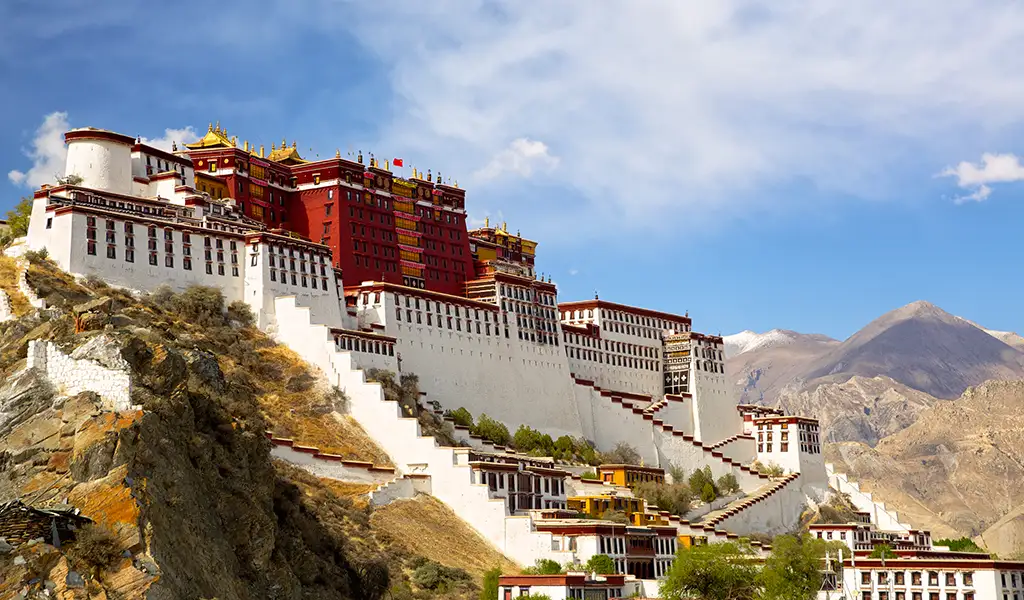
This complex has two significant sections. The White Palace was the Dalai Lama’s residence and the administration center. The Red Palace is for study, prayer, and sacred rituals. The two palaces together represent the dual nature of governance and spiritual authority. You can climb a long stone stairway to reach the palace. These long steps symbolize ascending to a higher realm of politics and faith.
The palace feels timeless. The dimly lit corridors open into chapels. You can see golden tomb stupas of the former Dalai Lamas and walls painted with centuries-old murals. These murals tell the stories of Tibetan kings, saints, and protectors. You can also see sunlight through small windows, casting a glow onto silk banners and carved altars. This palace is a living structure of cultural identity and resilience for Tibetans. The Potala Palace is a blend of art, architecture, and devotion for the rest of the world.
Historical Background
The story of Potala Palace goes back to the 7th century, when Tibet’s great King Songtsen Gampo built the fortress on the Red Hill of Lhasa. Today’s structure, however, is the legacy of the 5th Dalai Lama, Ngawang Lobsang Gyatso. He built the fortress after unifying Tibet in the mid-1600s and strengthening the Gelugpa schools’ independence. He envisioned a place symbolizing the union of religion and politics at the heart of Tibet. The construction began in 1645. This structure would later become one of Asia’s most remarkable architectural achievements.
The construction of the Potala Palace spanned over 40 years. Thousands of laborers and artisans from Tibet, Nepal, and China helped raise the walls, some nearly 3m thick. The 5th Dalai Lama passed away in 1682, but his prime minister didn’t inform anyone of it to ensure the project continued without disruption. Finally, the construction finished in 1694. The White Palace served as a residence and the seat of government, while the Red Palace was for prayer halls, shrines, and tombs of Dalai Lamas.
Potala Palace was the winter home of Tibet’s spiritual and political leaders. It served as a place to enthronement the Dalai Lamas, sign treaties, and make crucial decisions. It endured wars, invasions, and power shifts.
The authorities began restoring the palace in the 1980s and opened the palace for visitors in 1985.
UNESCO recognized it less than a decade later. The palace is a museum, a site of devotion, and a reminder of Tibet’s resilience and spiritual legacy.
Architectural Features
The Potala Palace is a blend of functionality, symbolism, and spiritual purpose. It has 13 floors and towers above Lhasa. The two main areas, White Palace and the Red Palace, served two different purposes in ancient Tibet. The White Palace was the Dalai Lama’s residence and the government center. The palace had offices, a seminar, and even a printing press. Sunlight Hall is a spacious summit room where the Dalai Lama conducted official business while enjoying the views of the city. The living quarters include his meditation room and bedroom with traditional furniture, carpets, and ritual objects. Visiting the palace gives you a glimpse of daily life centuries ago.
The Red Palace rises high and is the spiritual heart of the palace. The deep maroon walls surrounded many chapels, shrines, and memorial stupas for past Dalai Lamas. The most impressive is the 5th Dalai Lama, a 14m tall golden monument. It has thousands of precious stones and over 3,700 kg of gold. Other spaces include the Saint’s Chapel, one of the oldest sections of the palace, and the Namgyal Monastery Chapel, where the Dalai Lama’s monks performed daily rituals.
The palace is also an engineering masterpiece. The thick stone walls taper inward to withstand earthquakes. Artisans painted the white sections with lime and milk and red areas with natural pigments. Golden spires and roof pinnacles also add spiritual meaning and help drain rainwater. Over 2,500 square meters of murals tell the stories of religion, history, culture, statues, relics, and old scriptures. The Potala Palace is an excellent example of Tibetan artistry. It’s a place of worship, government, and protection all in one structure.
Spiritual and Religious Significance of Potala Palace
The Potala Palace is a powerful symbol of Tibetan Buddhism. It’s often called the “Second Mount Potalaka” after the legendary home of Avalokiteshvara. This name also reflects the belief that the Dalai Lama is a living manifestation of the Bodhisattva of Compassion.
A Repository of Sacred Relics and Rituals
The Potala Palace is a sacred treasure house with thousands of statues of Buddhas, bodhisattvas, and other deities. The chapels hold priceless scriptures, including complete collections of Kangyur and Tengyur. The most significant feature is the golden stupas of the past Dalai Lamas. These shrines contain the lamas’ remains and other holy objects. Tibetans believe the stupas radiate blessings and that pilgrims who perform kora here earn merit. A small group of monks continues daily rituals to keep the palace alive with prayer and devotion.
A Symbol of Unity and Faith
The Potala Palace is of great spiritual significance. The White Palace reflects the temporary earthly realm, while the Red Palace represents the spiritual. Together, they symbolize the Chösi Nyidhen, the dual system of spiritual and political leadership, which means the Dalai Lama rules from a place within a temple. During festivals, the Dalai Lama would appear on a balcony to bless the crowd below.
For Tibetan Buddhists, the Potala is a living path to enlightenment. Pilgrims circumambulate its base to perform kora, believing each step draws them closer to Avalokiteshvara’s blessings. The palace also played an essential role in state affairs as the Dalai Lama sought advice from state oracles in a special chapel. The Potala Palace is still a place of prayer and a symbol of Tibetan faith today. Its presence even without the Dalai Lama in the residence reflects the devotion of the Tibetan people and the enduring strength of their spiritual heritage.
Art, Culture, and Artifacts
The Potala Palace is a living museum of Tibetan art and culture with countless priceless treasures. The walls have beautiful murals, which also serve as records of history and lessons in Buddhism. These murals on dry plaster with mineral pigments depict scenes from the Buddha’s past lives, essential events in Tibetan history, and cosmological diagrams. The style reflects Chinese and Nepalese influences, highlighting Lhasa’s role as a cultural crossroad.
The palace also has a collection of statues and sculptures, from small figurines to large gilded bronze, copper, or clay statues. Many of these statues have precious stones like turquoise and coral. Potala also preserves religious artifacts and relics like the golden stupas of past Dalai Lamas.
Its library contains thousands of ancient scriptures and illuminated manuscripts decorated with gold and silver lettering. These scriptures offer valuable records of Buddhist philosophy and Tibetan history. It survived despite times of conflict and continues to educate and inspire visitors.
Preservation, Tourism, and Modern Context
The Palace faces both challenges and opportunities as a famous heritage site. The structure can withstand earthquakes, has improved drainage to prevent water systems, and has a modern fire-safety system. An expert team is also restoring murals and statues.
There is a limit on daily entries to manage the large number of tourists. Visitors should also follow a set route within a restricted time. It helps reduce damage from foot traffic and controls humidity in sensitive areas. The palace prohibits photographing the inside of the structure to protect fragile artworks.
The palace’s surroundings have changed to accommodate visitors. A large plaza surrounds the palace to boost tourism, limiting the height of the buildings to protect the skyline and local heritage.
The Potala is deeply sacred for Tibetans. The Chinese government uses its picture for tourism. It is a monument of Tibetan resilience where ancient faith and culture thrive amidst the demands of modern life.
Conclusion
The Potala Palace is a tribute to Tibet’s resilience and spiritual heritage. Its red and white walls symbolize temporal authority and sacred devotion. The 13 floors of the palace preserve the memories of Dalai Lamas, the prayers from generations of monks, and the art of a culture devoted to enlightenment.
Visiting the Potala means traveling to the heart of Tibet. You can smell the scent of butter lamps and incense in the air. You’ll gain a deep appreciation for Tibet’s religious and cultural legacy.
The palace survived through wars, political upheavals, and revolutions. It continues to shine as a symbol of Tibetan Buddhism. As a UNESCO World Heritage Site and with the ongoing preservation efforts, the Potala will inspire and educate future generations.